
Every price on Kyle Painting Pros comes with a source. This page explains where our cost figures come from, how we label them, what they include, and how often we update them. If you are a homeowner comparing quotes or a contractor checking our numbers against your own, this is the page that tells you how much weight to put on what we publish. Below, we break down the painting cost methodology using published, linked sources.
This page explains the rules behind every figure in our interior house painting cost guide and our other price pages.
Painting cost methodology: our core rule
No cost figure ships without a source. Every price, range, or rate on this site comes from one of two places:
- A named, published source with a date (for example, a cost guide from a major home-services site, or a government statistics release), linked inline where the number appears.
- Original data we collected ourselves, published with the method, sample size, and collection date.
We do not invent numbers, round them up to look tidy, or present a guess as data. When we cannot find a reliable figure, we say so.
Sources we use today
| Source | What we use it for | Notes |
|---|---|---|
| HomeGuide interior guide | Wall, ceiling, trim, door, and room costs; labor share; paint per gallon; coverage per gallon | Page titled 2026; byline dated Aug 28, 2023 |
| Angi interior guide | Whole-home project costs (65,117 projects) and per-sq-ft floor costs | 2026 data |
| Fixr | Alternate, higher whole-home range that assumes more prep | Published Jan 31, 2025; via secondary citation |
| HomeGuide cabinet guide | Cabinet cost per linear foot, per door, per kitchen | 2026 title |
| Angi cabinet guide | Cabinet project costs (13,847 projects), labor share | 2026 data |
| Angi exterior guide | Exterior cost per sq ft, project costs (39,126 projects), siding, trim, height adders, regional averages | Updated Oct 20, 2026 |
| This Old House | Alternate exterior siding ranges | From search snippet; not re-fetched |
| UseCalcPro | Paint price per gallon by quality tier | Secondary aggregator |
| U.S. Bureau of Labor Statistics (OEWS, May 2025) | Painter wages, national and by metro area | May 2025 estimates |
How we label figures
Each figure we store has a low, a high, a unit, and a source link. Many also have a “typical” value. We label typical values in one of two ways:
- Published average: the source itself published an average. Angi’s $2,022 interior project average is an example (Angi).
- Midpoint: the source published only a low and high, and we took the midpoint. When we use a midpoint, we call it a midpoint. It is a convenience, not a published statistic.
How we define scope
Painting costs vary mostly because of scope. We use these definitions consistently across the site:
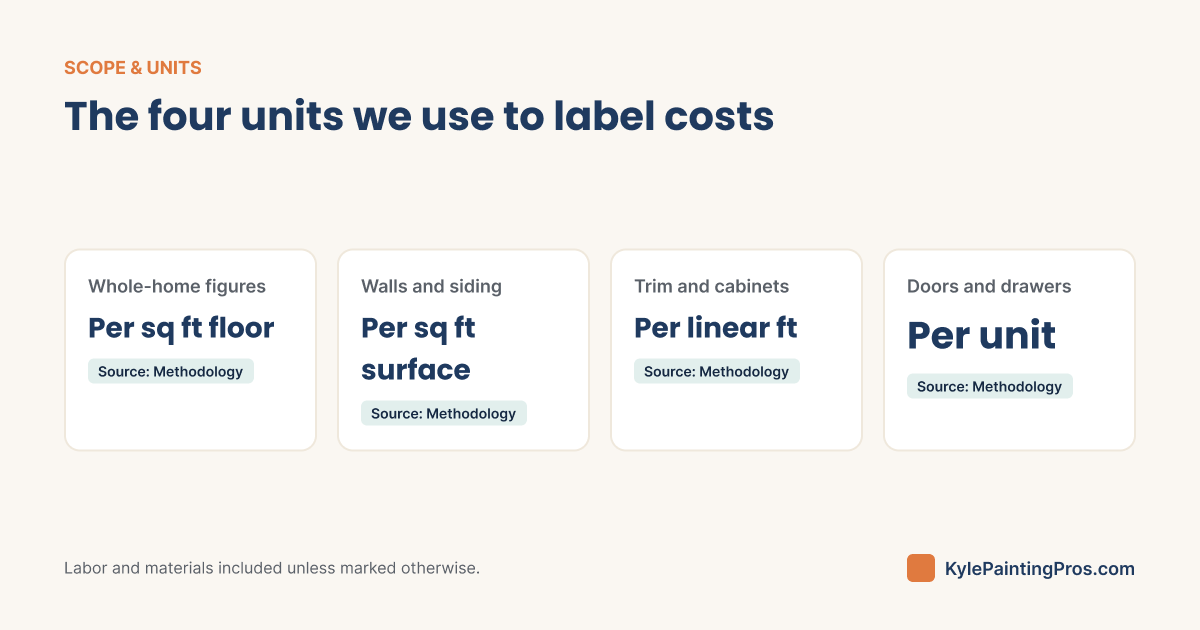
- Per square foot of floor area: the home’s or room’s floor area. Most whole-home figures use this unit.
- Per square foot of paintable surface: the actual area of wall, ceiling, or siding being painted. Wall-only and exterior figures usually use this unit.
- Per linear foot: trim, baseboards, soffits, fascia, and cabinets are priced by length.
- Per unit: doors, cabinet doors, and drawers are priced each.
- Labor and materials included unless a figure is marked labor-only or materials-only.
When sources disagree, we show more than one and explain why. Our article on why painting cost guides disagree goes into detail.
How our calculators use this data
The Painting Cost Estimator and Paint Calculator use the same dataset described here. The estimator multiplies your measurements by sourced per-unit rates and shows the low, typical, and high result. The paint calculator uses a coverage figure of up to 400 square feet per gallon per coat (HomeGuide), assumes two coats, and subtracts standard openings of about 21 square feet per door and 16 square feet per window (HomeGuide).
Regional and city adjustments
National averages hide big local differences. We use two public signals to describe them:
- Painter wages by metro area from the U.S. Bureau of Labor Statistics (OEWS, May 2025). We divide each metro’s median hourly wage for painters by the national median of $23.75 to get a labor-cost ratio. This measures labor cost only, not materials or overhead.
- Regional exterior project averages from Angi, which range from $2,300 in the Plains region to $4,800 in New England, against a national average of $3,178.
We do not use the RSMeans City Cost Index, which is the construction industry’s standard local cost index, because its values are behind a paywall. If we license it in future, we will say so here.
Known gaps
We would rather tell you what we don’t know:
- We have not verified a primary source for the labor share of exterior painting jobs.
- Fiber-cement siding painting costs are not on Angi’s exterior page; we only found a secondary citation, so we do not publish it as a sourced range.
- Paint price tiers come from a secondary aggregator.
- Fixr and This Old House figures came from search snippets and secondary pages rather than a fresh read of the original page.
- Major sources disagree sharply on whole-home interior costs, from about $2,000 to over $20,000, largely because of scope.
Painting cost methodology update schedule
- Quarterly: we re-check every cost source and update figures, the “Updated” date on each cost page, and this methodology page.
- Annually: we refresh BLS wage data when the new OEWS release is out.
- As needed: if a source changes its method or a reader reports an error, we correct the page and note the change.
Corrections
If you are a contractor or homeowner and you think a figure is wrong for your market, we want to hear about it, especially with documentation. Reader-reported data will only be published once it meets the same rule as everything else: a clear method, a sample size, and a date.
How to use our figures in practice
Worked example: reading a “typical” value
Our interior wall rate is stored as $1 to $2 per square foot of wall surface from HomeGuide, with a typical value of $1.50. That $1.50 is a midpoint we calculated, not a number HomeGuide published, and we label it that way. By contrast, the $2,022 interior project figure is a published average from Angi, based on 65,117 projects. When you see both on our site, the published average carries more weight because it reflects real reported jobs.
Worked example: checking a figure yourself
Every figure links to its source. To verify the exterior average, open Angi and look for the project range of $1,819 to $4,551 and average of $3,178. If the source has changed since our last check, tell us and we will update the page and note the date.
Worked example: how a regional ratio is built
The U.S. Bureau of Labor Statistics (OEWS, May 2025) reports a national median painter wage of $23.75 per hour. If a metro’s median were $29.53, as BLS reports for the New York-Newark-Jersey City area, the labor ratio would be 29.53 / 23.75 = 1.24. That means painter wages there run about 24% above the national median. It does not mean a whole job costs 24% more, because materials, overhead, and profit also vary.
Painting cost methodology in five rules
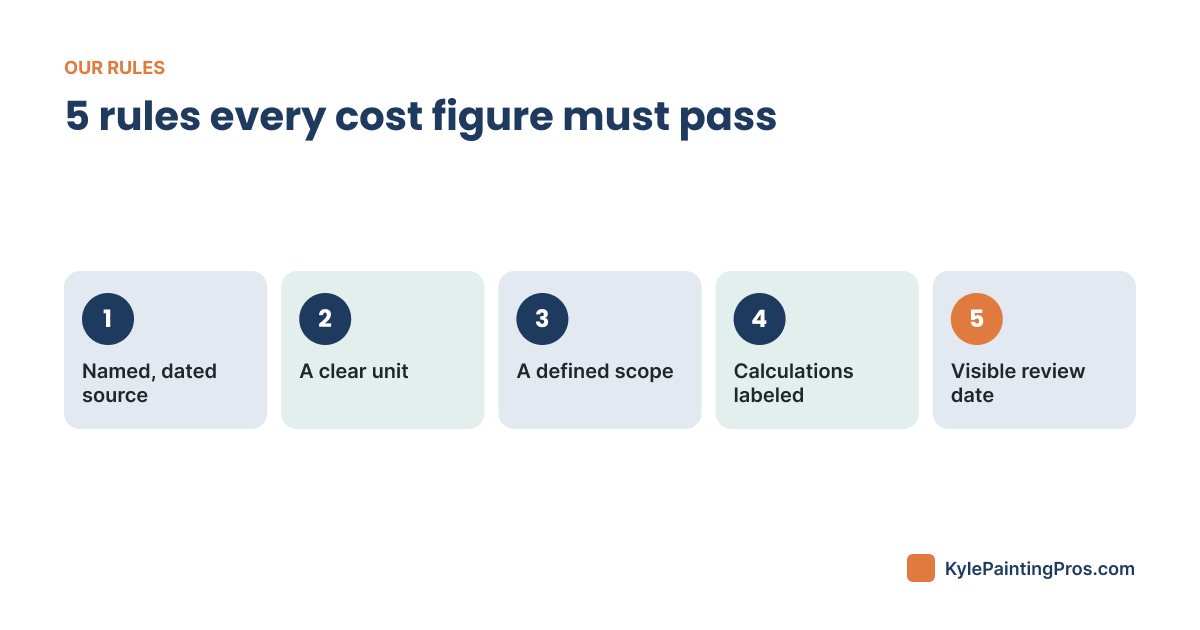
Our painting cost methodology comes down to five rules that apply to every guide, table, and calculator on this site. They are short on purpose, so readers and editors can check any page against them.
- Rule 1: Every number has a named source. A figure without a link and a date does not get published.
- Rule 2: Every number has a unit. Floor area, paintable surface, linear foot, or each. A range without a unit is not comparable to anything.
- Rule 3: Every number has a scope. We say whether ceilings, trim, doors, and prep are included or excluded.
- Rule 4: Calculations are labeled as calculations. When we multiply a published rate by a room size, we say so, and we never present the result as a quote or a survey finding.
- Rule 5: Every page has a review date. Readers can see when the figures were last checked against the source.
How we choose sources
Not every cost page on the web is equally useful. Before a source enters our dataset, an editor checks it against a short list of questions.
What we look for
- Transparency about method. Does the source say whether its figures come from booked projects, contractor surveys, or a modeled job? Sources that report a sample size, as Angi does, rank higher.
- Clear units and scope. Can we tell whether a price is per square foot of floor or of wall, and what work it covers?
- Recency. Is there a publish or update date? If a page carries a current-year title but older underlying data, we record both dates.
- Independence. Government statistics, such as wage data from the Bureau of Labor Statistics, give us a baseline that does not depend on any marketplace.
What we avoid
- Figures that appear only in advertising or lead-generation forms with no stated method.
- Numbers repeated across many sites with no original source we can trace.
- Single anecdotes, forum posts, or one-off quotes presented as averages.
When we have to use a secondary source, such as an aggregator that summarizes other data, we label it as secondary in the table and in the text.
Our editorial review process
Each cost page passes through the same steps before it is published or updated.
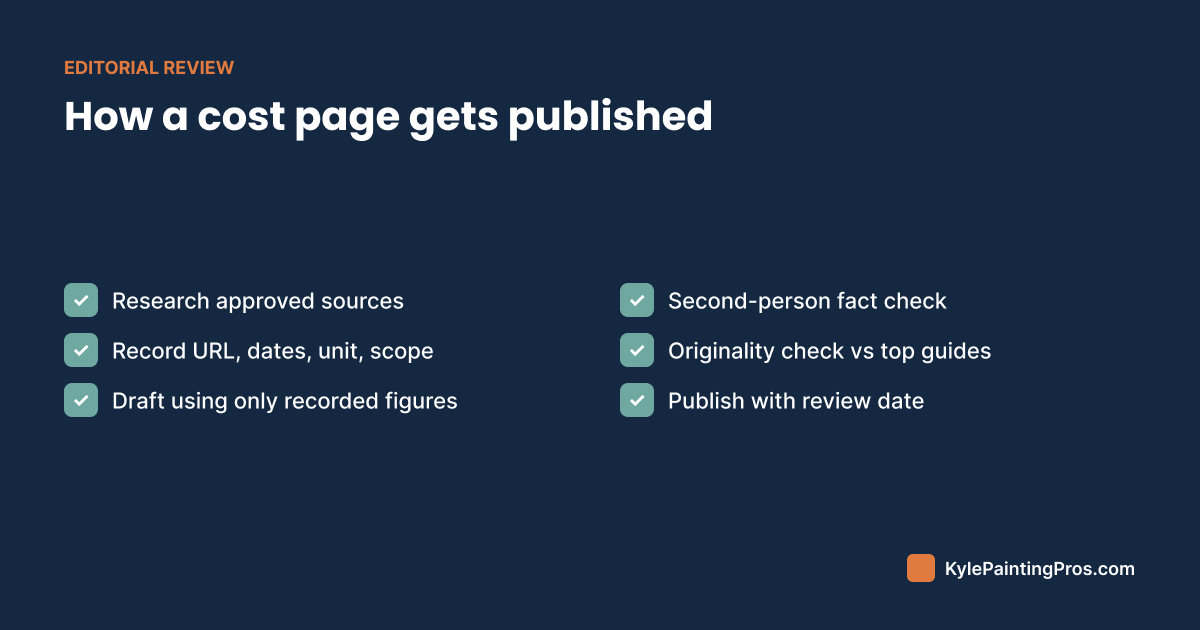
- Research: an editor collects figures from the approved sources and records the URL, publish date, access date, unit, and scope for each.
- Drafting: the writer uses only figures from that record. Any arithmetic, such as a worked example, is shown step by step.
- Fact check: a second reviewer opens every linked source and confirms that each figure, unit, and attribution matches.
- Originality check: we compare the draft against the leading cost guides on the same topic to make sure our explanations and structure are our own, not a rewrite of someone else’s page.
- Publishing: the page goes live with a visible review date and a link back to this methodology page.
How this methodology serves homeowners and contractors
Homeowners use our pages to budget and to judge whether a quote is reasonable. For them, the most important parts of this painting cost methodology are scope labels and units, because those explain why a quote may not match a national average. Our guide to the cost to paint a house interior and the cost to paint a room show these labels in action.
Contractors use our pages differently. They want to know how their own prices compare to what customers see online, and how to explain the gap. The business-side guides, how to estimate a painting job and markup vs margin, apply the same sourcing rules but focus on production rates and pricing math rather than consumer averages.
What our figures are not
Being clear about limits is part of a trustworthy method. Our published figures are:
- Not quotes. A quote comes from a contractor who has seen your home.
- Not local prices. National ranges hide wide regional differences, which we discuss on each page where data exists.
- Not guarantees. Prices change with labor markets and material costs between our reviews.
If you need a number for a specific project, use our figures to frame the conversation, then get written, itemized quotes from local, insured painters.
Painting cost methodology in action: a worked walkthrough
To show how the painting cost methodology works day to day, here is the path a single figure takes before it appears on our site.
1. Find the figure at its source
We open the publisher’s page directly and record the exact range, the unit (per project, per square foot of floor, per square foot of wall, per linear foot, or per item), and the date we accessed it.
2. Label the scope
We note what the figure includes: labor, materials, prep, ceilings, trim, or only walls. If a publisher does not say, we label the scope as unstated rather than guessing.
3. Compare it with other sources
If two sources measure the same thing in the same unit, we show both. If they measure different things, we explain the difference instead of averaging them.
4. Publish with a link
The figure goes live only with a working citation beside it. Under our painting cost methodology, an unlinked number is treated as an error.
What our painting cost methodology does not do
- We do not invent local prices for cities we have not sourced.
- We do not blend different units into one “average” number.
- We do not present an estimate as a quote. Only a contractor who has seen your project can quote it.
- We do not keep stale figures. When a source updates, so do we, or we flag the figure as dated.
How readers can check our work
Every price on our cost guides links to its source, so you can open the original page and confirm the range yourself. If you find a mismatch, tell us and we will review it under the corrections policy above. This openness is the core promise of our painting cost methodology: you should never have to take a number on trust.
Regional caveats we apply nationally
Our guides serve readers across the country, so we use national figures by default. Labor rates vary widely by metro area; the U.S. Bureau of Labor Statistics publishes painter wage data by state and metro that shows how much labor costs can differ. When we discuss regional differences, we point readers to that kind of primary data rather than inventing local multipliers.
Key takeaways
- Our painting cost methodology starts with a citation: if we cannot link a source, we do not publish the figure.
- Every figure is labeled with its unit and scope, which is the core of our painting cost methodology.
- We review figures on a schedule and log changes, so the painting cost methodology stays transparent over time.
See the rules applied in our cost to paint a room guide, our exterior painting cost guide, and our explainer on why published painting prices differ. The Painting Cost Estimator uses the same labeled ranges.
Painting cost methodology FAQs
Why don’t you publish one single “average cost to paint a house”?
Because the major sources measure different scopes, and a single number would hide that. We show ranges and explain the scope behind each.
Do your figures include labor and materials?
Yes, unless a figure is specifically labeled as labor-only or materials-only.
Why do some pages show figures from secondary sources?
When a primary source isn’t available or couldn’t be re-checked, we say so next to the figure and in the Sources section, so you can weigh it accordingly.
How do I know when a page was last checked?
Each cost page shows an Updated date and lists the date we accessed every source.
Can contractors submit pricing data?
Yes. We will only publish it in aggregate, with the method, sample size, and collection date shown.
Does your painting cost methodology use contractor surveys?
We prefer figures based on real project data or clearly described pricing studies. When a source relies on surveys or editorial estimates, we label it so readers can weigh it accordingly.
How often does the painting cost methodology change?
The rules rarely change, but the figures they govern are reviewed on a schedule. Any change to the rules themselves is noted on this page.
Why not publish a single national price?
A single number hides scope and unit differences. Our painting cost methodology shows ranges with their scope so you can match them to your project.
Sources
- HomeGuide and HomeGuide, accessed Nov 4, 2026.
- Angi, Angi, and Angi, accessed Nov 4, 2026.
- Fixr, This Old House, UseCalcPro, accessed Nov 4, 2026.
- U.S. Bureau of Labor Statistics (OEWS, May 2025), May 2025 estimates.
Notes