
Painting kitchen cabinets is one of the most popular ways to change the look of a kitchen without replacing it. It is also one of the most labor-intensive painting jobs, which is why professional prices range so widely. This guide sets out what the published data says, why the numbers differ, and how DIY compares. Below, we break down the cabinet painting cost using published, linked sources.
Painting the kitchen walls as well? See our interior house painting cost guide for room and whole-home ranges.
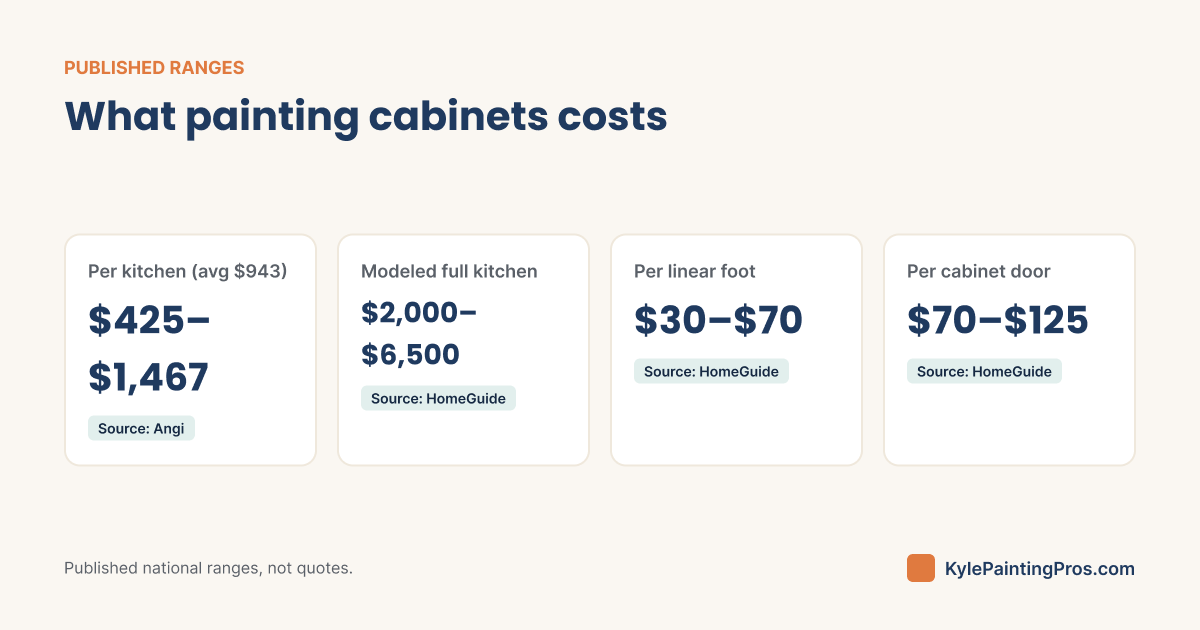
Quick answer: Angi reports homeowners paid $425 to $1,467, an average of $943, to paint kitchen cabinets, based on 13,847 projects. HomeGuide puts a typical kitchen much higher, at $2,000 to $6,500, or $30 to $70 per linear foot.
Cabinet painting cost at a glance
| Measure | Published range | Source |
|---|---|---|
| Per kitchen (booked projects) | $425 to $1,467 (average $943) | Angi |
| Per average kitchen (modeled) | $2,000 to $6,500 | HomeGuide |
| Per linear foot | $30 to $70 | HomeGuide |
| Per linear foot | $30 to $60 | Angi |
| Per linear foot, spray finish | $40 to $100 | HomeGuide |
| Per cabinet door | $70 to $125 | HomeGuide |
| Per cabinet door | $100 to $250 | Angi |
| Per drawer | $30 to $110 | HomeGuide |
| Labor share of cost | 70% to 80% | Angi |
Why the sources disagree
Angi’s average comes from projects its users reported, which include small kitchens, partial jobs, and simpler finishes. HomeGuide models a full professional refinish of an average kitchen. Neither is wrong; they describe different jobs. Use the per-door and per-linear-foot figures to price your own kitchen instead of relying on either headline. We go deeper on this in why painting cost guides disagree.
What you’re paying for
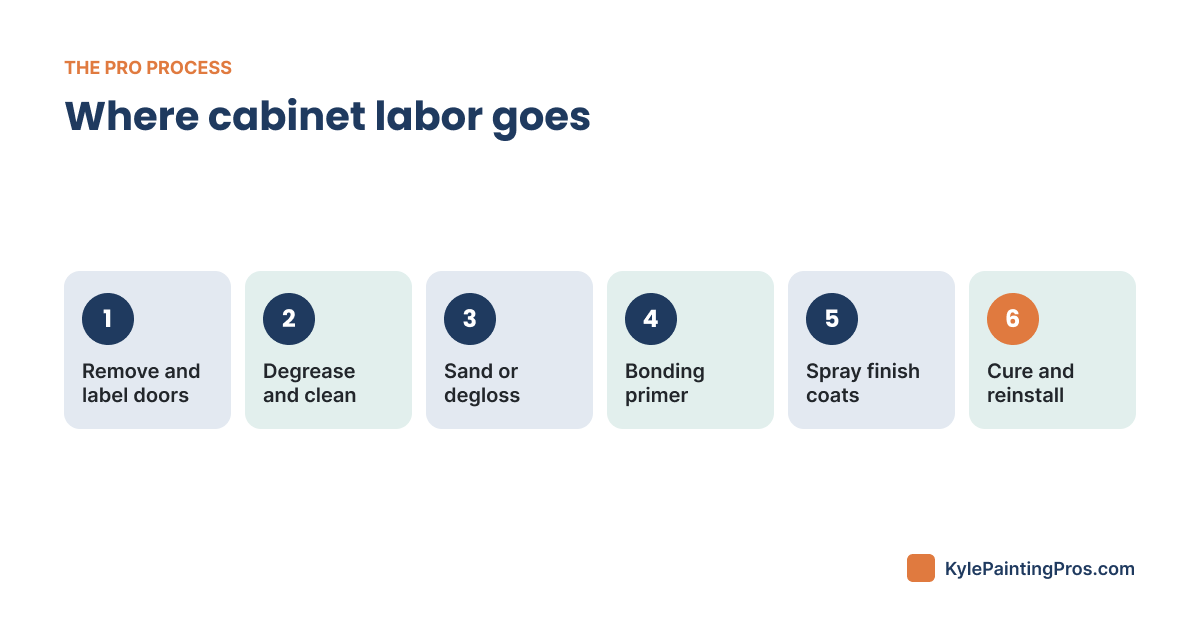
Cabinet painting is mostly labor, 70% to 80% of the cost according to Angi. A professional cabinet job typically involves:
- Removing doors, drawers, and hardware, and labeling everything.
- Deep cleaning to remove grease, which otherwise prevents adhesion.
- Sanding or deglossing the existing finish.
- Filling dings, and sometimes old hardware holes.
- Priming with a bonding primer.
- Applying finish coats, often sprayed for a smooth factory-like finish.
- Curing, then reinstalling and adjusting doors.
Each step takes time, and skipping any of them is the main reason DIY cabinet jobs chip and peel.
How to estimate your kitchen
By linear foot: measure the run of upper and lower cabinets along the wall. Multiply by $30 to $70 (HomeGuide).
By door and drawer: count doors and drawers, then multiply by per-unit prices: $70 to $125 per door and $30 to $110 per drawer (HomeGuide).
A worked example
A kitchen with 20 doors and 8 drawers, priced with HomeGuide’s per-unit rates:
- Doors: 20 x $70 to $125 = $1,400 to $2,500
- Drawers: 8 x $30 to $110 = $240 to $880
- Total: $1,640 to $3,380
The same kitchen with 25 linear feet of cabinets at $30 to $70 per linear foot comes to $750 to $1,750. The gap between methods shows why you should get itemized quotes. These are calculations on published rates, not quotes.
Our Painting Cost Estimator can help you price cabinets alongside the rest of your project.
What raises the cost
- Spray finish: smoother result, higher price; HomeGuide lists $40 to $100 per linear foot.
- Color change from dark wood to white: more primer and coats.
- Oak and other open-grain woods: grain filling for a smooth look adds labor.
- Glazing, two-tone, or distressed finishes.
- Repairs: damaged doors, peeling laminate, or water damage.
- Islands and built-ins add linear footage.
DIY cabinet painting cost
DIY saves the labor, which is the bulk of the bill. Your costs are materials and tools:
- Paint: a durable cabinet-grade enamel. Premium interior paints fall roughly in the $55 to $80 per gallon tier according to UseCalcPro, a secondary aggregator.
- Bonding primer: HomeGuide lists interior primer at $10 to $30 per gallon; specialty bonding primers can sit above that.
- Supplies: degreaser, sandpaper, wood filler, quality brushes and foam rollers, painter’s tape, and drop cloths.
- Optional: a paint sprayer for a smoother finish.
Most kitchens need about one to two gallons of finish paint for two coats, plus primer. Use the Paint Calculator to estimate quantity from the surface area of doors and boxes.
The real cost of DIY
The biggest DIY cost is time. Doors need to dry and cure between coats, and the kitchen is out of commission while they do. Cabinets also see heavy daily wear, so a rushed prep job shows quickly. If you’re unsure, consider painting a test door or a bathroom vanity first.
DIY vs pro: how to decide
| Factor | DIY | Professional |
|---|---|---|
| Cost | Materials and tools only | Angi: $425 to $1,467; HomeGuide: $2,000 to $6,500 |
| Finish | Brush/roll; spray if you own a sprayer | Often sprayed, very smooth |
| Time | Several days to weeks | Typically faster |
| Durability | Depends heavily on prep | Usually warrantied |
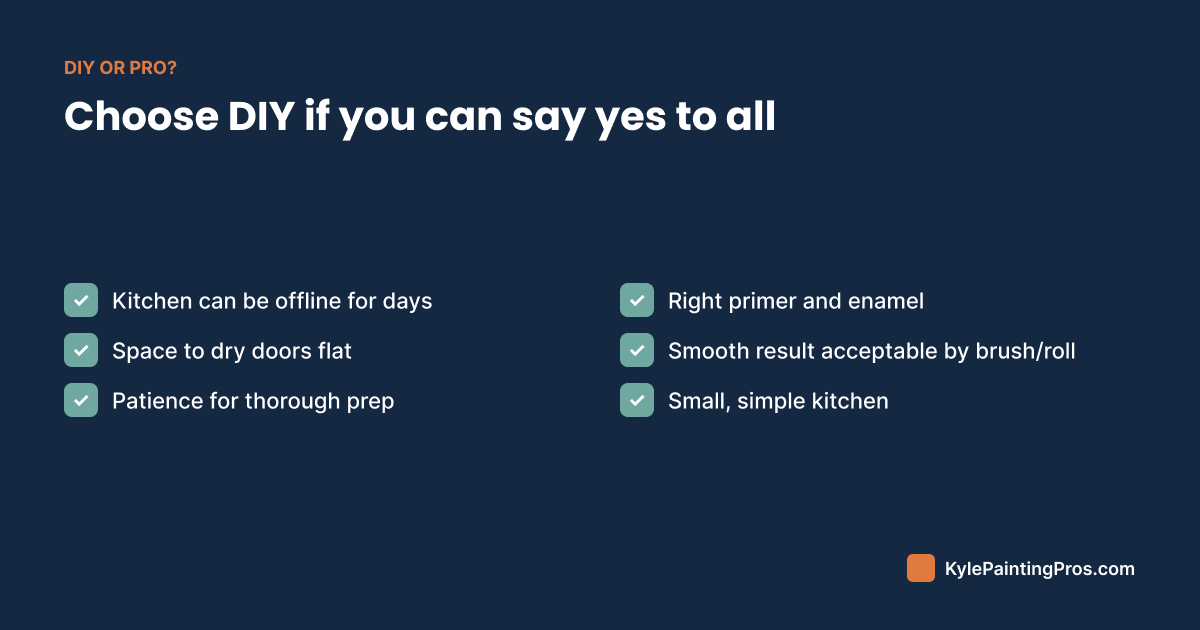
Hire a pro if you want a sprayed finish, have a large kitchen, or can’t give up the kitchen for long. DIY is reasonable for small kitchens, laundry rooms, and vanities.
Painting vs refacing vs replacing
Painting is the lowest-cost way to change cabinet color. Refacing (new doors and veneers on existing boxes) and full replacement cost more but solve layout or damage problems. If the boxes are solid and you like the layout, painting is usually the best value.
Worked example: an L-shaped kitchen with an island
A kitchen with 18 linear feet of lower cabinets, 14 linear feet of uppers, and a 6-foot island has 38 linear feet. These are calculations on published rates, not quotes.
| Method | Calculation | Cost range |
|---|---|---|
| Brush/roll, HomeGuide | 38 x $30 to $70 | $1,140 to $2,660 |
| Spray finish, HomeGuide | 38 x $40 to $100 | $1,520 to $3,800 |
| Angi linear-foot range, Angi | 38 x $30 to $60 | $1,140 to $2,280 |
Worked example: DIY materials
For a mid-size kitchen, assume 1.5 gallons of finish paint (buy 2) and 1 gallon of bonding primer. At UseCalcPro‘s premium tier of $55 to $80 per gallon and HomeGuide‘s $10 to $30 primer range, paint and primer run $120 to $190, before degreaser, sandpaper, and applicators. Compare that with the pro ranges above to see what your time is worth.
Cabinet painting cost and the materials behind it
Cabinet boxes and doors are made from different materials, and each one needs different prep. That is one reason cabinet painting cost varies so widely between kitchens.
- Solid wood: usually paints well after cleaning, deglossing, and priming. Open-grain woods such as oak may need grain filling for a smooth finish, which adds labor.
- MDF: takes paint smoothly, but raw edges absorb primer and need sealing.
- Laminate: needs a bonding primer made for slick surfaces.
- Thermofoil: is often a poor candidate because the vinyl skin can peel; many painters decline it or recommend replacement.
Ask your painter which materials your cabinets are made of and how their process handles them.
Brush, roll, or spray?
Finish method affects both price and appearance.
- Brush and roll is the lowest-cost method and suits DIY projects, but brush marks can show.
- Spraying produces a smooth, factory-like finish. It needs masking, a spray area, and equipment, so it usually costs more.
- Hybrid approaches spray the doors off-site and brush or roll the boxes in place.
If you want the smoothest finish, ask whether doors and drawer fronts are sprayed.
Cure time and living with the project
Paint can feel dry within hours but take much longer to fully cure and harden. The exact time depends on the product, so follow the manufacturer’s label. During that period, treat surfaces gently: avoid heavy scrubbing, and do not hang towels on doors. Plan for some days without full use of the kitchen while doors are off and drying, and ask your contractor for a realistic schedule.
Picking a finish that lasts
Cabinets get touched constantly, so durability matters more than on walls.
- Choose a product made for cabinets, trim, or furniture rather than standard wall paint.
- Satin and semi-gloss sheens are common because they clean easily.
- Lighter colors can show grime; darker colors can show chips and dust.
- Consider new hinges and hardware at the same time, as worn hardware can make fresh paint look tired.
Questions to ask before you hire
- What prep steps do you include, and do you degrease and sand?
- Which primer and topcoat will you use?
- Are doors sprayed, and where?
- How long will the kitchen be out of use?
- How are doors labeled so they go back in the right place?
- What does your warranty cover?
Clear answers make bids easier to compare. For a broader look at quote differences, see why painting cost guides disagree, and use the Painting Cost Estimator to check the total against other rooms you plan to paint. Our cost to paint a room guide is helpful if you are painting the kitchen walls too. Understanding cabinet painting cost line by line makes it easier to decide between DIY, hiring a pro, or refacing.
Cabinet painting cost: a scope checklist for quotes
Cabinet quotes vary because scope varies. Ask every contractor to price the same list so the cabinet painting cost is easy to compare.
- Number of doors, drawer fronts, and cabinet boxes.
- Interiors of boxes: included or excluded?
- Island, pantry, vanity, or built-ins.
- Degreasing, sanding, and grain filling.
- Primer type and number of topcoats.
- Spray finish for doors, and whether that is on site or in a shop.
- Removing and reinstalling hardware and hinges.
- New hardware supply and installation.
- Labeling and reinstalling doors in the correct positions.
Worked example: same kitchen, two finishes
Picture one kitchen priced twice. The first quote brushes and rolls everything in place with one coat of primer and two finish coats. The second removes the doors, sprays them in a shop, and brushes the boxes on site. The second quote costs more, but it delivers a smoother finish and keeps the kitchen usable for part of the job. When you compare cabinet painting cost quotes, look at method and finish, not just the total.
Prep and paint quality factors
Cleaning and degreasing
Kitchen cabinets carry grease that stops paint from sticking. Thorough degreasing is essential and adds time.
Sanding and priming
Light sanding and a bonding primer help paint grip glossy surfaces. Skipping this step is a common reason painted cabinets chip.
Topcoat quality
Cabinet and trim enamels level smoothly and cure harder than wall paint. Follow the manufacturer’s data sheet for recoat and cure times.
Regional cost caveats
The ranges in this guide come from national sources such as Angi and HomeGuide. Labor drives most of the cabinet painting cost, and painter wages vary by state and metro area according to the U.S. Bureau of Labor Statistics. Expect local quotes to sit higher or lower than the national midpoint.
A DIY vs pro decision framework
- DIY fits if you have time to remove, label, and paint doors over several days, a place to let them dry, and patience for sanding and multiple coats.
- Hire a pro if you want a sprayed finish, cannot lose the kitchen for long, or have many doors.
- Hybrid: remove and label doors yourself and ask a pro to spray them, if a contractor offers that option.
Include your time, tools, and the risk of redoing chipped work when you compare the DIY cabinet painting cost with a professional quote.
Common estimate mistakes
- Counting doors but forgetting drawer fronts.
- Leaving out the island or pantry.
- Assuming interiors are included.
- Skipping degreasing and primer in a DIY budget.
- Rushing reinstallation before paint cures.
Avoiding these keeps your cabinet project on budget and the finish durable.
Cabinet painting cost vs the value it adds
Painting is often chosen because it refreshes a kitchen without the disruption of replacement. When you weigh cabinet painting cost, consider how long you plan to stay, the condition of the cabinet boxes, and whether the layout works. If the boxes are sturdy and the layout suits you, painting usually delivers the biggest visual change for the money. If boxes are damaged, warped, or the layout is a daily frustration, refacing or replacement may be the better long-term choice, even though the upfront price is higher. Compare those options side by side using the ranges in this guide.
Caring for painted cabinets
Clean painted cabinets with a soft cloth and mild soap, avoid abrasive pads, and wipe spills quickly. Keep a labeled container of the original paint for touch-ups. Good care protects your investment and keeps the cabinet painting cost from turning into a repeat expense.
Key takeaways
- Cabinet painting cost depends on cabinet count, materials, prep, and whether doors are sprayed.
- DIY saves on labor but adds time and risk, so compare the full cabinet painting cost of each option.
- Get itemized quotes that list prep, primer, topcoat, and warranty before you choose.
To compare cabinet painting cost quotes fairly, ask each painter to describe the same items: how many doors and drawer fronts, whether boxes and interiors are included, how they will clean and degrease, what primer and topcoat they use, and whether doors are sprayed off site. Ask how long the kitchen will be out of use and how hardware will be handled. Two quotes that look far apart often describe different work. Once the scope matches, the cabinet painting cost comparison becomes much clearer, and you can weigh price against prep quality, finish durability and warranty instead of the headline number alone.
For walls, see the cost to paint a room; for DIY materials, see how much paint you need. The Painting Cost Estimator helps compare cabinets with other projects.
Frequently asked questions
How much does it cost to paint kitchen cabinets?
Angi reports an average of $943 (range $425 to $1,467); HomeGuide reports $2,000 to $6,500 for an average kitchen.
How much per cabinet door?
$70 to $125 per door according to HomeGuide; Angi lists $100 to $250.
Is it cheaper to paint or replace cabinets?
Painting is typically far cheaper, since you keep the existing boxes and doors.
How long does cabinet paint take to cure?
It varies by product. Check the manufacturer’s cure time, not just the dry time, before reinstalling doors and using the kitchen heavily.
Do I need to remove the doors?
For a professional-looking finish, yes. Painting doors flat avoids drips and lets you paint both sides properly.
Will painted cabinets chip?
Poor adhesion is the usual cause. Thorough degreasing, sanding, and a bonding primer are the best protection.
Can laminate or thermofoil cabinets be painted?
Sometimes, with the right bonding primer, but adhesion is harder and peeling thermofoil can’t be fixed with paint. Ask a painter to look at the material before quoting, and test a hidden spot first if you’re doing it yourself. If the surface is already lifting, refacing may be the better route.
Does cabinet painting cost include the inside of the cabinets?
Usually not. Most quotes cover door and drawer fronts and the exterior of the boxes. Interiors are often an add-on.
Why is cabinet painting cost so much higher than painting walls?
Cabinets need degreasing, sanding, priming, multiple thin coats, and careful handling of doors and hardware. That detailed labor drives the price.
Can I lower my cabinet painting cost?
Removing hardware, emptying cabinets, and keeping the same layout help. Choosing a brushed finish instead of spraying may also lower the price, at the cost of a less smooth look.
How long does a professional cabinet job take?
It depends on the number of doors, the method, and cure times. Ask each contractor for their schedule and when the kitchen will be usable.
Is cabinet painting cost worth it compared with new cabinets?
If the boxes are solid and the layout works, painting usually changes the look for far less than replacement. If the boxes are damaged or the layout needs to change, replacing may be the better long-term choice.
Sources
- HomeGuide, Cost to Paint Kitchen Cabinets (2026 title), accessed Nov 4, 2026.
- Angi, How Much Does It Cost to Paint Kitchen Cabinets (2026 data), accessed Nov 4, 2026.
- HomeGuide and UseCalcPro (secondary), accessed Nov 4, 2026.
Notes