
Buying too little paint means a second trip to the store and a risk of mismatched batches. Buying too much wastes money. The good news is that figuring out how much paint you need takes a tape measure and five minutes. This guide shows the formula, the numbers behind it, and worked examples. Or skip the math and use our free Paint Calculator.
Once you know the quantity, our interior painting cost guide shows how materials fit into a full project budget.
Quick answer: One gallon of paint covers up to about 400 square feet per coat (HomeGuide), and most jobs need two coats. A typical 12 by 12 foot bedroom with 8-foot ceilings needs about 2 gallons for the walls.
How much paint do I need? The formula
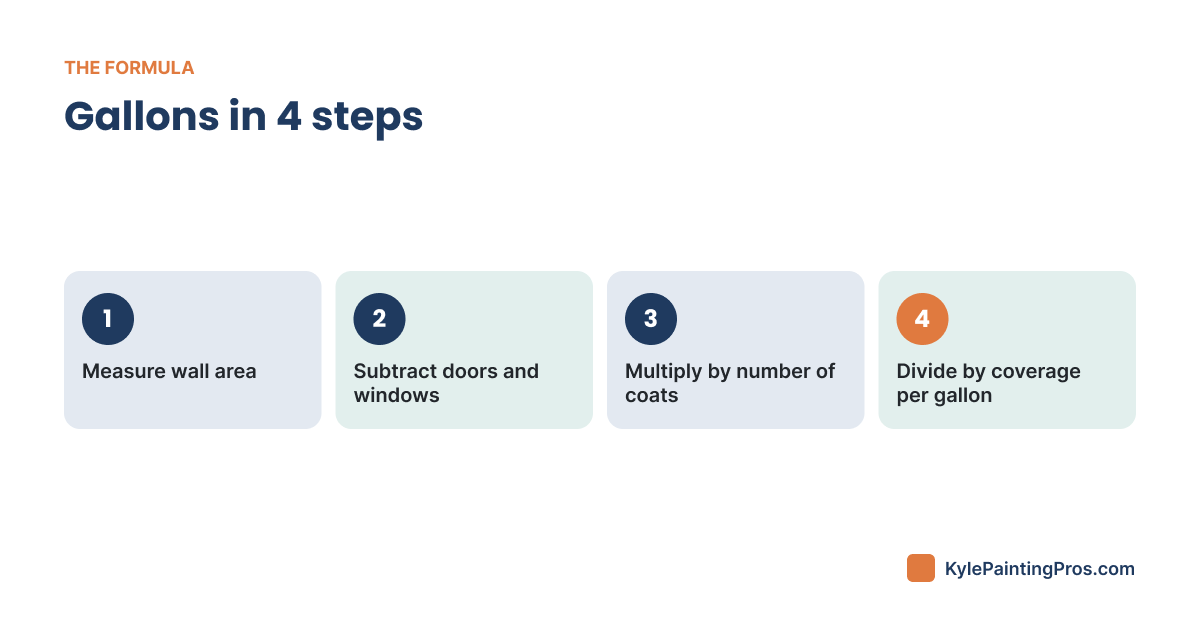
Gallons = (Paintable area x Number of coats) / Coverage per gallon
Then round up to the next whole gallon (or quart for small amounts).
The numbers we use
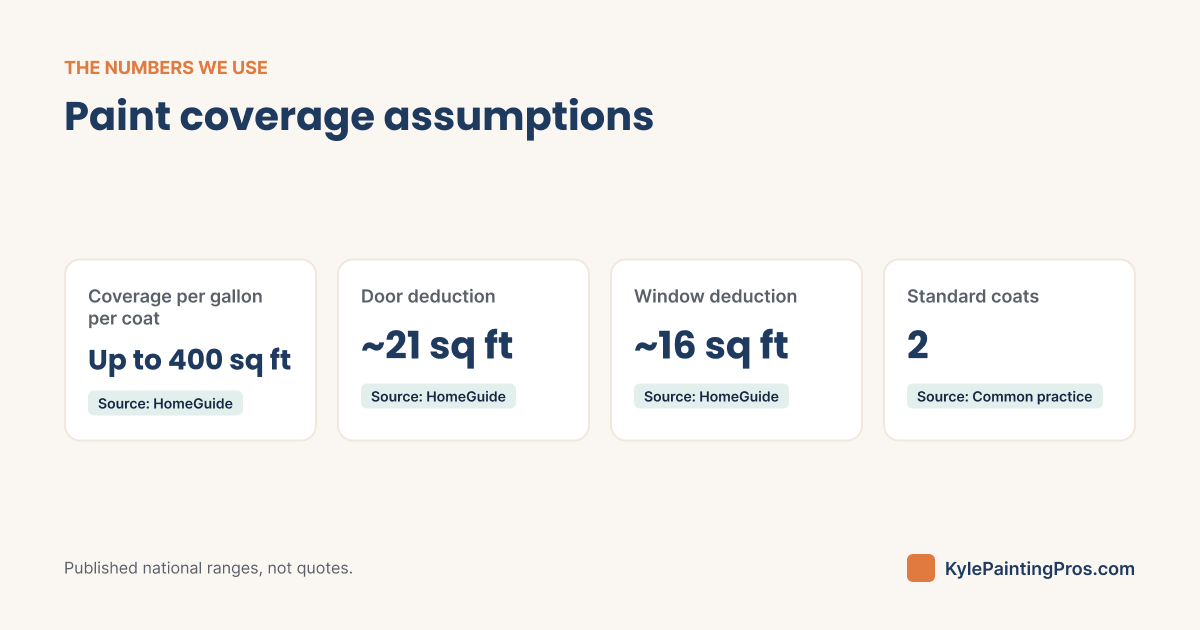
| Input | Value | Source |
|---|---|---|
| Coverage per gallon per coat | 350 to 400 sq ft | HomeGuide (up to 400); UseCalcPro (350 to 400) |
| Standard number of coats | 2 | Industry standard; used in our calculator |
| Door deduction | about 21 sq ft each | HomeGuide |
| Window deduction | about 16 sq ft each | HomeGuide |
Coverage drops on rough, porous, or textured surfaces. A secondary source, CostToRenovate, notes that stucco can absorb 30% to 50% more paint. Always check the coverage printed on your specific can.
Step 1: Measure the walls
- Measure the length of each wall and add them together. That is the perimeter.
- Measure the ceiling height.
- Multiply perimeter by height.
A 12 by 12 room has a perimeter of 48 feet. At 8 feet tall: 48 x 8 = 384 square feet.
Step 2: Subtract doors and windows
Subtract about 21 square feet per door and 16 per window (HomeGuide). With one door and one window: 384 – 21 – 16 = 347 square feet.
For small openings this barely matters, and many painters skip it to leave a margin. For rooms with lots of glass or several doors, it adds up.
Step 3: Multiply by coats
Two coats is standard: 347 x 2 = 694 square feet of coverage.
When do you need more?
- Dark to light color changes: often a primer coat plus two finish coats.
- New drywall: needs primer, which soaks in.
- Bold colors such as reds and yellows: sometimes need a third coat.
When might one coat do? Repainting the same color over a clean, sound finish, though two coats still give the most even result.
Step 4: Divide by coverage
694 / 400 = 1.74 gallons. Round up: buy 2 gallons.
Ceilings
Ceiling area is the same as floor area: length x width. Ceiling paint is usually a separate flat product, so calculate it separately.
Trim and doors
Trim uses little paint. For baseboards and casing in a typical room, a quart of trim paint is often plenty. Doors are about 21 square feet per side; two coats on both sides of a door is roughly 84 square feet.
Whole-house paint estimate
For a whole house, add up the net wall area of every room, then apply the formula. If you don’t want to measure every room, our Paint Calculator can estimate from floor area and ceiling height.
Exterior paint quantity
The same formula works outside. Measure each wall’s length x height, add triangular gable ends (base x height / 2), subtract large openings, then apply coats and coverage. Rough siding, stucco, and masonry need more paint than the can’s rated coverage.
What will the paint cost?
Once you know gallons, multiply by price:
- Interior paint: about $15 to $50 per gallon (HomeGuide); UseCalcPro groups 2026 interior paint from $20 to $35 (economy) to $55 to $80 (premium).
- Exterior paint: Angi lists latex or acrylic at $20 to $50 per gallon.
- Primer: about $10 to $30 per gallon for interior (HomeGuide).
For the 12 by 12 bedroom above, two gallons of mid-tier paint, which UseCalcPro lists at $35 to $55, would run $70 to $110. If you are deciding between DIY and hiring a painter, compare that with professional costs in our guide to the cost to paint a room, or price the whole job in the Painting Cost Estimator.
Tips to avoid running short
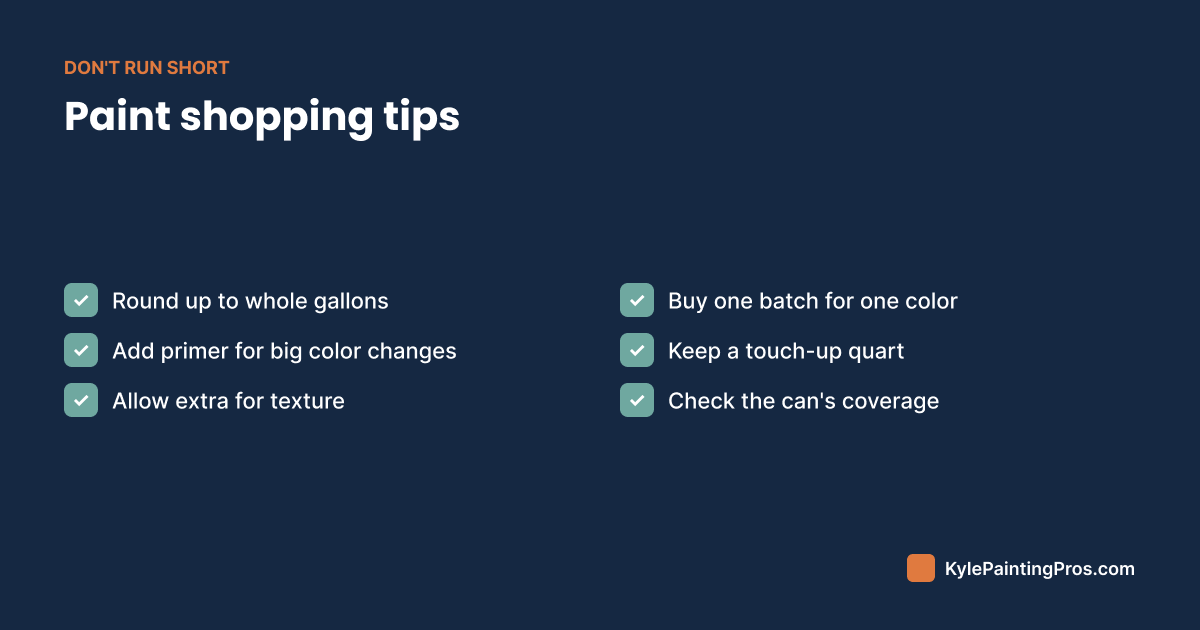
- Buy all your paint at once so the color is from the same batch, or box (mix) cans together before you start.
- Keep a little extra for touch-ups, and label it with the room and date.
- Textured, porous, or freshly patched walls need more.
Worked examples
These use 400 square feet per gallon, two coats, and 8-foot ceilings with one door and one window. They are arithmetic, not product recommendations.
| Room | Net wall area | Coverage needed (2 coats) | Gallons (walls) | Ceiling (2 coats) |
|---|---|---|---|---|
| 10 x 10 ft | 283 sq ft | 566 sq ft | 1.4, buy 2 | 200 sq ft, buy 1 |
| 12 x 12 ft | 347 sq ft | 694 sq ft | 1.7, buy 2 | 288 sq ft, buy 1 |
| 12 x 14 ft | 379 sq ft | 758 sq ft | 1.9, buy 2 | 336 sq ft, buy 1 |
| 14 x 16 ft | 443 sq ft | 886 sq ft | 2.2, buy 3 | 448 sq ft, buy 2 |
| 16 x 20 ft | 539 sq ft | 1,078 sq ft | 2.7, buy 3 | 640 sq ft, buy 2 |
When you are slightly over a whole gallon, a gallon plus a quart may be enough.
Worked example: a whole floor
Say you’re painting three bedrooms and a hallway, with net wall areas of 347, 379, and 443 square feet, plus a 200 square foot hallway. Total: 1,369 square feet. Two coats: 2,738 square feet. At 400 square feet per gallon (HomeGuide): 6.8 gallons, so buy 7 (or a 5-gallon bucket plus two gallons if the color is the same everywhere).
Worked example: dark to light with primer
Covering a dark 12 by 12 room (347 square feet net) with a light color:
- Primer, one coat: 347 / 400 = 0.87 gallons, so buy 1.
- Finish, two coats: 694 / 400 = 1.7 gallons, so buy 2.
- At HomeGuide‘s $10 to $30 per gallon for primer and UseCalcPro‘s $35 to $55 mid-tier paint, materials run about $80 to $140.
Worked example: exterior gable
A gable end 30 feet wide and 10 feet tall at the peak is 30 x 10 / 2 = 150 square feet. Add that to the rectangular wall below before calculating gallons.
How much paint do I need for different projects?
The formula stays the same for every job, but the inputs change. Here is how to apply it to the projects people ask about most.
A single accent wall
Measure the width and height of the wall, subtract any openings, and multiply by two coats. One wall rarely needs more than a gallon. If you are changing to a bold, deep color, check the label: some deep shades need a tinted primer or an extra coat.
A whole room
Add up all four walls, subtract doors and windows, multiply by coats, and divide by coverage. Ceilings are measured separately (length times width) and usually use a different paint.
Trim and doors
Trim and doors use far less paint than walls. A quart often handles the trim in a typical room. If you are painting several doors in the same color, a gallon is usually the better buy.
Exterior siding
Exterior surfaces vary more. Rough or porous siding absorbs more paint than smooth siding, so expect lower coverage than the can’s best-case figure. Always read the manufacturer’s coverage range for your surface.
Choosing primer and when you need it
Primer is not always necessary, but it saves paint and frustration in the right situations:
- Bare drywall, new plaster, or patched areas.
- Bare wood or stained surfaces that might bleed through.
- Big color changes, especially dark to light.
- Glossy surfaces that need help with adhesion.
Primer is measured the same way as paint. Calculate the area, divide by the primer’s coverage, and usually plan for one coat.
Paint calculator mistakes to avoid
Most shortfalls come from a few simple errors:
- Forgetting the second coat. Most estimates assume two coats of finish paint.
- Using floor area instead of wall area. Walls usually have much more area than the floor.
- Ignoring texture. Textured or rough surfaces absorb more paint.
- Rounding down. Always round up to the next whole gallon or add a quart.
- Mixing batches. If you buy more later, the color can vary slightly between batches. Box the cans (mix them together) for consistency.
Storing leftover paint
Leftover paint is useful for touch-ups. Seal the lid tightly, label the can with the room and date, and store it somewhere that does not freeze or get very hot. If you no longer need it, check your local rules for paint disposal or recycling; many areas run take-back programs.
Use our tools
Our Paint Calculator does the math in this guide automatically. If you are also budgeting labor, try the Painting Cost Estimator, or read our guide to the cost to paint a room. Knowing how much paint do I need before you shop keeps both your budget and your schedule on track.
How much paint do I need? A room-by-room checklist
Before you head to the store, write down each surface and how much paint it needs. This simple list answers the question “how much paint do I need?” for the whole project, not just one wall.
- Wall area for each room, minus doors and windows.
- Ceiling area for each room.
- Trim length and number of doors.
- Number of coats for each surface.
- Primer needs for patches, bare surfaces, or big color changes.
- Sheen and color for each surface, since each combination is a separate purchase.
Worked example: a bedroom from start to finish
Imagine a bedroom with four walls, one door, and two windows. Measure each wall’s width and multiply by the height to get total wall area. Subtract the door and windows. Multiply by two coats. Divide by the coverage figure in this guide, and round up to the next whole gallon. Then do the ceiling separately, and plan a quart for the trim. Writing each step down makes it easy to see how much paint do I need for every surface, and avoids a second trip to the store.
Paint quality and coverage
Coverage on the can is a best-case figure. Real coverage depends on the surface and the product.
Surface factors
- Smooth, previously painted walls get the best coverage.
- New drywall, bare wood, and textured surfaces absorb more.
- Rough exterior siding can use much more than smooth siding.
Product factors
- Higher-quality paints often hide better, which can save a coat.
- Deep and bright colors may need extra coats or a tinted primer.
- Paint-and-primer products help on sound surfaces but do not replace primer on bare or stained areas.
Read the manufacturer’s data sheet for the exact coverage range you should use in the formula.
DIY vs pro: who buys the paint?
If you hire a painter, ask whether materials are included. Many contractors buy paint at trade pricing and include it in the quote. If you supply paint yourself, use this guide to work out how much paint do I need, then confirm the quantity and product with your painter so nothing is wasted. Our guide to the cost to paint a room shows how materials fit into a full budget.
Common estimate mistakes
- Measuring floor area instead of wall area.
- Forgetting the ceiling or trim.
- Planning one coat for a dramatic color change.
- Using best-case coverage on textured or porous surfaces.
- Buying separate small cans instead of one larger container for big areas.
Regional and seasonal notes
Paint prices vary by store, region, and season, and many retailers run sales around holidays. The quantity you need does not change, so work out how much paint do I need first, then shop for the best price on that amount. For current price ranges, see the sources cited in this guide.
How much paint do I need for an exterior?
Measure each wall of the house: width times height for rectangular walls, and half the base times height for gable triangles. Add them together, subtract large openings such as garage doors, and multiply by the number of coats. Divide by the coverage figure for your siding type, using the lower end for rough or porous surfaces. Trim, fascia, and doors are calculated separately, usually in a different sheen. Because exterior surfaces vary so much, it is wise to buy a little extra and keep a gallon for touch-ups. Working out how much paint do I need for each elevation also helps you plan the job day by day.
Key takeaways
- How much paint do I need? Measure wall area, subtract openings, multiply by coats, and divide by coverage.
- Round up, and remember textured or porous surfaces use more paint than the can’s best-case coverage.
- Primer is calculated the same way when you work out how much paint do I need for a big color change.
Once you have an answer to how much paint do I need, round up to whole containers and keep a little extra for touch-ups. Write the brand, color name, finish and batch details on the lid so the same paint can be matched later. If the job spans several rooms, mixing (boxing) gallons of the same color in a larger bucket helps keep the shade consistent from wall to wall. Before buying, check the coverage figure printed on the label of the product you choose, because it can differ from the general rule of thumb used here. Then run the numbers through our calculator to double-check the total.
Budget labor too with our cost to paint a room guide, and for cabinet projects see cabinet painting costs. Painting outside? Check the exterior house painting cost ranges. The Paint Calculator does this math for you.
How much paint do I need: FAQs
How much paint do I need for a 12×12 room?
About 2 gallons for two coats on the walls, assuming 8-foot ceilings, one door, and one window, and 400 square feet per gallon.
Does primer count as a coat?
Primer prepares the surface and improves adhesion and coverage, but you usually still need two finish coats over it for full color.
How many square feet does a gallon of paint cover?
HomeGuide cites up to 400 square feet per gallon per coat. UseCalcPro cites 350 to 400. Rough surfaces get less.
Should I buy a 5-gallon bucket?
If you need four or more gallons of one color, a 5-gallon bucket is often cheaper per gallon and avoids batch mismatches.
How much paint does a door need?
About 21 square feet per side (HomeGuide). Two coats on both sides is about 84 square feet, well under a quart.
Does textured wall need more paint?
Yes. Rough and porous surfaces absorb more; budget extra and check the can’s rated coverage.
How much paint do I need for a ceiling?
Measure the ceiling’s length and width, multiply them, and divide by the coverage figure. Ceilings usually need one or two coats of a flat ceiling paint.
How much paint do I need if I’m using paint-and-primer?
Calculate the same way as regular paint. Paint-and-primer products can help on sound surfaces, but bare drywall, stains, and big color changes still benefit from a separate primer.
Is it better to buy too much or too little paint?
Slightly too much. Leftover paint is useful for touch-ups, while running short can mean a second trip and a possible color mismatch between batches.
How much paint do I need for a small bathroom?
Use the same formula. Small rooms often need less than a gallon of wall paint, but bathrooms usually benefit from a moisture-resistant, washable sheen.
How much paint do I need for two coats?
Calculate the area once, multiply it by two, and then divide by the coverage figure. Round up to the next whole gallon so you finish both coats from the same batch.
Sources
- HomeGuide, accessed Nov 4, 2026.
- UseCalcPro (secondary aggregator), accessed Nov 4, 2026.
- Angi, accessed Nov 4, 2026.
- CostToRenovate (secondary), accessed Nov 4, 2026.
Notes