
Painting a single room is the most common painting job in America, and it is also one of the easiest to estimate yourself. This guide shows what professionals charge, how room size changes the price, and what you would spend doing it yourself, using published figures with every source linked. Below, we break down the cost to paint a room using published, linked sources.
Planning more than one room? Our guide to painting a whole house interior covers full-home budgets.
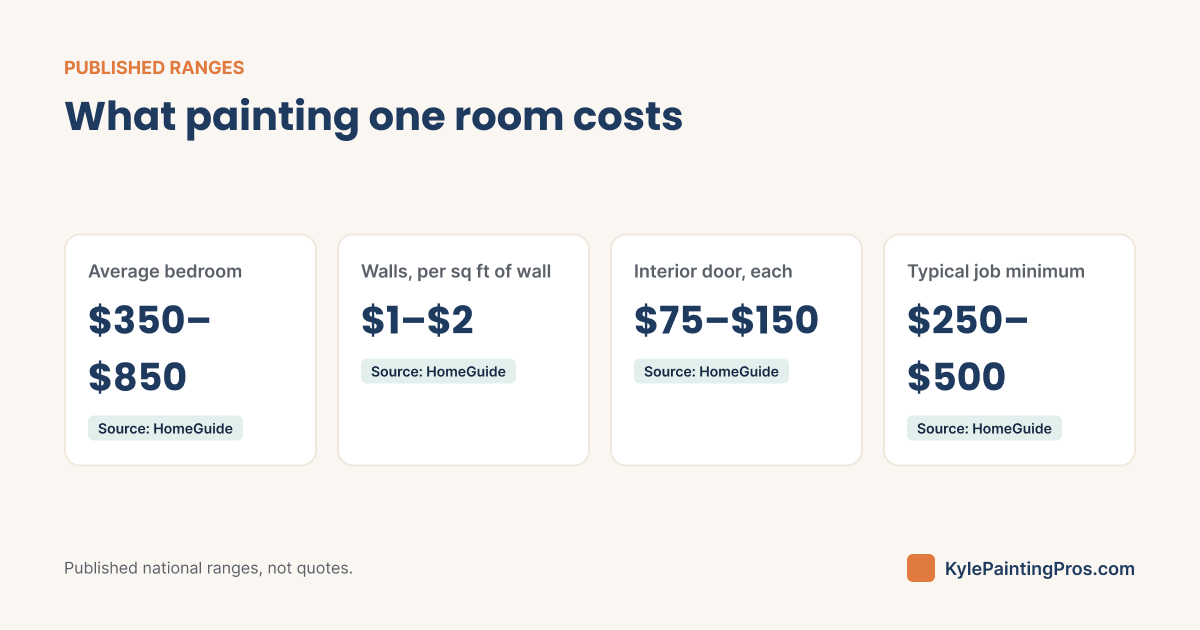
Quick answer: HomeGuide reports that painting an average bedroom costs $350 to $850 with labor and materials. On a per-area basis, HomeGuide lists $1 to $3 per square foot of coverage area for a room, and $1 to $2 per square foot for walls only.
Cost to paint a room at a glance
| Item | Published range | Source |
|---|---|---|
| Average bedroom | $350 to $850 | HomeGuide |
| Room, per sq ft of coverage | $1 to $3 | HomeGuide |
| Walls only, per sq ft of wall | $1 to $2 | HomeGuide |
| Ceiling, per sq ft | $1 to $2 | HomeGuide |
| Trim, per linear ft | $1 to $4 | HomeGuide |
| Interior door, each | $75 to $150 | HomeGuide |
| Typical job minimum | $250 to $500 | HomeGuide |
How to measure a room’s paintable area
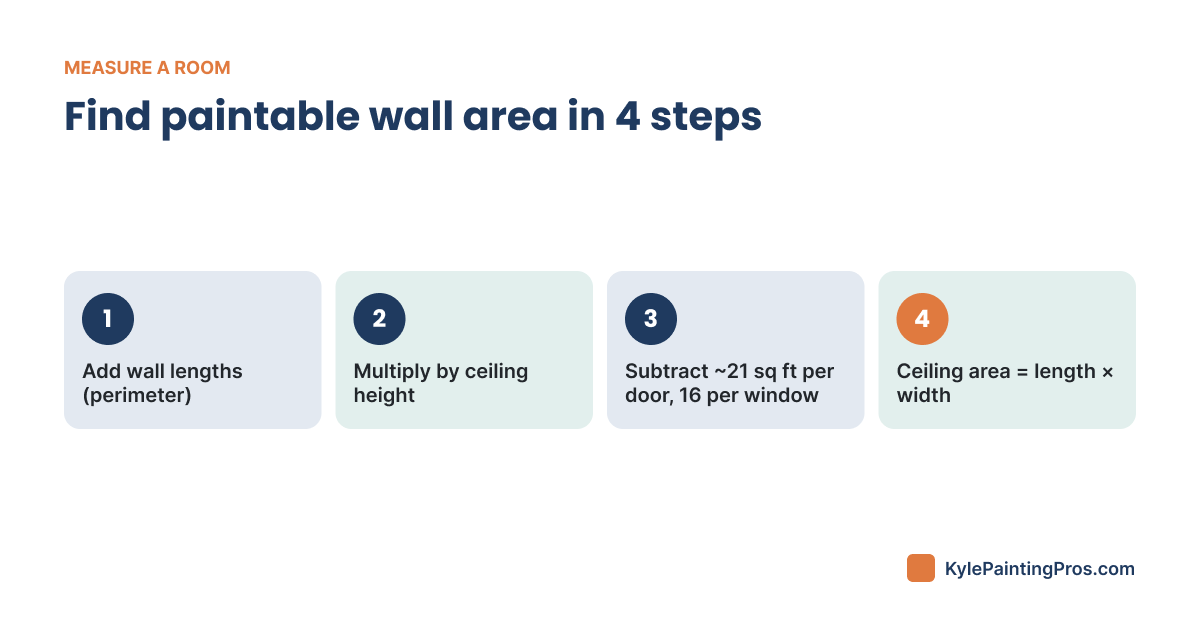
Painters price by the area they paint, not the floor. Here is the quick method:
- Add up the wall lengths (the room’s perimeter). A 12 by 12 room has a 48-foot perimeter.
- Multiply by ceiling height. At 8 feet, that is 384 square feet of wall.
- Subtract openings. HomeGuide uses about 21 square feet per door and 16 square feet per window.
- Ceiling area equals floor area (length x width).
Our Paint Calculator does this automatically and tells you how much paint you need.
Estimated cost by room size
The table below applies HomeGuide’s published walls-only rate of $1 to $2 per square foot of wall to common room sizes, assuming 8-foot ceilings, one door, and one window. These are arithmetic examples using a sourced rate, not quotes.
| Room size | Wall area (net) | Walls only at $1 to $2/sq ft | Ceiling at $1 to $2/sq ft |
|---|---|---|---|
| 10 x 10 ft | 283 sq ft | $283 to $566 | $100 to $200 |
| 12 x 12 ft | 347 sq ft | $347 to $694 | $144 to $288 |
| 12 x 14 ft | 379 sq ft | $379 to $758 | $168 to $336 |
| 14 x 16 ft | 443 sq ft | $443 to $886 | $224 to $448 |
| 16 x 20 ft | 539 sq ft | $539 to $1,078 | $320 to $640 |
Net wall area = perimeter x 8 ft, minus 21 sq ft for one door and 16 sq ft for one window. Small rooms may hit a painter’s job minimum of $250 to $500 (HomeGuide).
Notice that the 12 by 12 bedroom, walls only, lands inside HomeGuide’s $350 to $850 bedroom range. Add ceiling and trim and you move toward the top of it.
What changes the price of a room
Room type
Bedrooms and living rooms are open wall. Kitchens and bathrooms have less wall but more cutting in around cabinets, tile, and fixtures, which takes time. Expect a higher cost per square foot of wall in these rooms even when the total is similar.
Ceiling height
Vaulted ceilings and two-story rooms add wall area and require taller ladders or scaffolding. Stairwells are the classic example: small in floor area, expensive to paint.
Color change
A dramatic change, especially dark to light, can need primer plus two coats. Standard estimates assume two coats.
Condition and texture
Patching, sanding, and caulking add labor. Textured walls take more paint and time; HomeGuide lists a texture add-on of $0.80 to $2.00 per square foot.
Labor
Labor makes up 70% to 85% of interior painting costs (HomeGuide). HomeGuide lists painter rates of $20 to $50 per hour, and many painters charge a job minimum, which is why one small room can cost nearly as much as a larger one.
DIY cost to paint a room
If you do it yourself, you pay only for materials and supplies. Paint is the main cost:
- Paint: HomeGuide lists interior paint at about $15 to $50 per gallon. UseCalcPro, a secondary aggregator, groups 2026 prices from $20 to $35 (economy) through $55 to $80 (premium) per gallon.
- Primer: about $10 to $30 per gallon (HomeGuide), if needed.
- Coverage: up to 400 square feet per gallon per coat (HomeGuide).
For the 12 by 12 bedroom above, 347 square feet of wall x 2 coats is 694 square feet, or about 1.7 gallons at 400 square feet per gallon. In practice, you buy two gallons. See How Much Paint Do I Need? for the full method.
You will also need rollers, brushes, tape, drop cloths, and patching compound if you do not already own them.
Should you hire a pro for one room?
Hiring makes sense when:
- The room has high ceilings, a stairwell, or lots of trim.
- You want a flawless finish on cabinets, doors, or trim.
- You are bundling several rooms, so the job minimum is spread across more work.
DIY makes sense when the room is a standard bedroom with walls in good shape and you have a weekend to spare.
Tips to lower the cost
- Bundle several rooms into one job to avoid paying multiple minimums.
- Move furniture and remove wall hangings yourself.
- Keep the same color family to avoid extra coats.
- Ask for walls-only pricing if ceilings and trim are still in good condition.
Worked example: a full bedroom with ceiling, trim, and door
Let’s price a complete 12 by 14 foot bedroom using HomeGuide’s published unit rates (HomeGuide). These are calculations, not quotes.
| Item | Quantity | Rate | Cost range |
|---|---|---|---|
| Walls (net) | 379 sq ft | $1 to $2/sq ft | $379 to $758 |
| Ceiling | 168 sq ft | $1 to $2/sq ft | $168 to $336 |
| Baseboard | 52 linear ft | $1 to $4/linear ft | $52 to $208 |
| Interior door | 1 | $75 to $150 | $75 to $150 |
| Total | $674 to $1,452 |
Baseboard length is the 52-foot perimeter. Walls alone sit within HomeGuide’s $350 to $850 bedroom range; the full scope runs above it. That is the most common reason a quote comes in higher than an online average.
Worked example: DIY materials for the same room
- Walls: 379 sq ft x 2 coats / 400 sq ft per gallon = 1.9 gallons, so buy 2.
- Ceiling: 168 x 2 / 400 = 0.84 gallons, so buy 1.
- At UseCalcPro‘s mid-tier range of $35 to $55 per gallon, three gallons cost $105 to $165, before tools and supplies.
Cost to paint a room by room type
Room size explains a lot, but room type matters too. Here is how the main rooms in a home usually differ, and what to tell a painter so the cost to paint a room is quoted accurately.
Bedrooms
Bedrooms are the benchmark job, and they are the room type behind HomeGuide’s bedroom range. They usually have open walls, one door, one or two windows, and a closet. Ask whether the closet interior is included, because it adds cutting in and is often priced separately.
Living and family rooms
These rooms tend to be larger, may have higher or vaulted ceilings, and often open to other spaces. Where a living room flows into a hallway or dining room without a door, decide in advance where the paint color will stop. A clean break at an inside corner is easier and cheaper than a line in the middle of a wall.
Kitchens
Kitchens have less paintable wall because cabinets and backsplash cover much of it. The time goes into careful cutting in around cabinets, counters, and appliances. If you also want cabinets painted, that is a separate and much larger job, covered in our cabinet painting cost guide.
Bathrooms
Bathrooms are small, but they are fiddly. Painters work around toilets, vanities, tile, mirrors, and fixtures in a tight space. Moisture also matters, so a washable sheen and a paint suited to humid rooms are common choices.
Hallways and stairwells
Hallways have lots of doors and trim relative to wall area. Stairwells add height and awkward access, often needing extension poles, tall ladders, or scaffolding. Expect these areas to cost more per square foot of wall than a bedroom.
Step-by-step: what a painter does in one room
Knowing the steps makes it easier to compare quotes and understand where the time goes.
- Protect: move and cover furniture, lay drop cloths, and mask switches and outlets or remove their covers.
- Prep: fill nail holes and cracks, sand patches smooth, caulk gaps at trim, and spot-prime repairs and stains.
- Cut in: brush a clean band along ceilings, corners, and trim.
- Roll: apply the first coat to the open wall, let it dry, then apply the second coat.
- Trim and doors: paint baseboards, casings, and doors if they are in scope.
- Clean up: remove masking, replace covers, return furniture, and do a final walkthrough for touch-ups.
On a typical bedroom, prep and cutting in can take as long as rolling. That is why rooms with lots of trim, damage, or corners cost more than their floor size suggests.
Questions to ask before you hire someone for one room
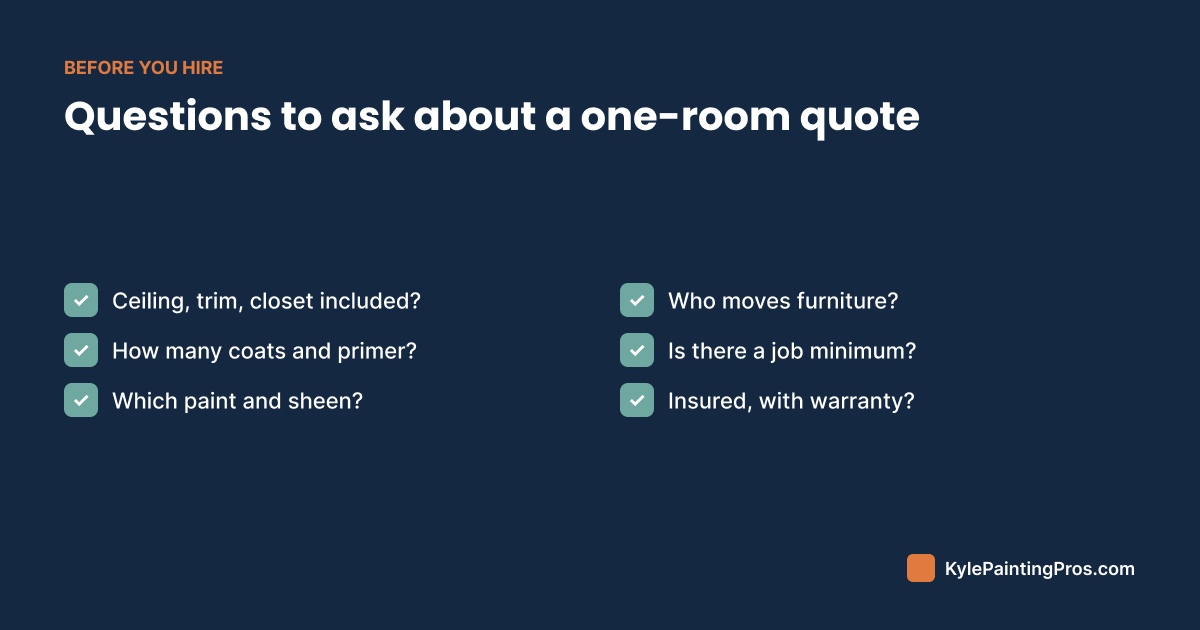
- Does the price include the ceiling, trim, closet, and door, or only the walls?
- How many coats are included, and is primer included where needed?
- Which paint brand, product line, and sheen will be used?
- Who moves the furniture, and who patches holes?
- Is there a job minimum, and could adding a second room be good value?
- Is the painter insured, and is the work covered by a written warranty?
If you are comparing two quotes for the cost to paint a room, line up the answers side by side. Often the cheaper quote leaves something out.
How a single room fits into a whole-house plan
Painting one room at a time works well when you are refreshing gradually. If you plan to paint several rooms within a year, it may be worth quoting them together, because job minimums and setup time are spread across more area. Our house interior painting cost guide covers whole-home budgets, and the cost per square foot guide shows how to convert between room and whole-house pricing.
Cost to paint a room: a scope checklist for quotes
Before you ask anyone for a price, write down exactly what is included. A clear scope is the easiest way to make the cost to paint a room comparable from one contractor to the next.
- Walls only, or walls plus ceiling?
- Baseboards, door and window casings, and crown molding?
- Doors, and both sides or one?
- Closet interiors?
- Patching, caulking, and spot priming?
- Number of coats and paint product line?
- Furniture moving and floor protection?
- Cleanup and touch-up walkthrough?
Worked example: walls only vs full scope
Picture a mid-sized bedroom. A walls-only quote covers four walls with two coats. A full-scope quote adds the ceiling, baseboards, casings, and one door. The full-scope room takes noticeably longer because cutting in trim and painting the ceiling are slow, detailed work. That is why the cost to paint a room can differ widely for the same floor plan. Always confirm which scope a published range or a quote describes before comparing.
Prep and paint quality factors
Two things that rarely show on a summary price have a big effect on how long a paint job lasts.
Prep
Filling holes, sanding patches, caulking gaps, and spot priming take time but make the finish look smooth. Skipping them saves money now and costs more later.
Paint quality
Higher-quality paints generally cover better and resist scuffing, which can mean fewer coats. Check the manufacturer’s data sheet for coverage and recoat times rather than relying on the label’s marketing.
Regional cost caveats
The ranges in this guide are national. Labor makes up most of the cost to paint a room, and painter wages vary by state and metro area according to the U.S. Bureau of Labor Statistics. Expect quotes in high-cost metros to sit higher in the range and quotes in lower-cost areas to sit lower.
DIY vs hiring a pro: a quick decision framework
- DIY makes sense for a single, standard-height room with walls in good shape, a color similar to the old one, and time to do it carefully.
- Hire a pro for high ceilings, heavy repairs, dark-to-light changes, detailed trim, or when you cannot lose the room for a weekend.
- Consider a hybrid: hire out the ceiling and trim and roll the walls yourself.
Whichever route you choose, compare the full cost to paint a room yourself, including tools, tape, drop cloths, and your time, against a pro’s itemized quote.
Common estimate mistakes for a single room
- Using floor area instead of wall area.
- Forgetting the ceiling or trim in a DIY budget.
- Underestimating coats for a big color change.
- Ignoring a contractor’s job minimum, which can make one small room cost more per square foot than several rooms together.
Knowing these pitfalls helps keep the cost to paint a room predictable from the first quote to the final walkthrough.
Cost to paint a room vs a whole floor
If several rooms need paint, ask for a price on the group as well as each room on its own. Setup, travel, and cleanup are spread across more space, which usually lowers the cost to paint a room when rooms are bundled.
Key takeaways
- The cost to paint a room depends on wall area, ceiling height, prep, and whether trim and ceilings are included.
- Measure your walls first; it makes the cost to paint a room easier to compare across quotes.
- Use our calculators to check the cost to paint a room before you book a painter.
A simple way to keep the cost to paint a room under control is to decide the scope before you ask for prices. List the walls, ceiling, trim, doors and any closets you want painted, note the condition of each surface, and pick a finish. Share that same list with every painter you contact so the quotes cover the same work. If one quote is much lower, ask what it leaves out rather than assuming it is a better deal. Writing down the scope also helps you see which items you could handle yourself, such as moving furniture or patching small holes, to lower the cost to paint a room without cutting corners.
Compare your room against interior painting rates per square foot, check materials with how much paint you need, and use the Paint Calculator for quick gallon counts. Painting cabinets too? See our cabinet painting cost guide.
Frequently asked questions
How much does it cost to paint a 12×12 room?
Using HomeGuide’s $1 to $2 per square foot walls-only rate, about $347 to $694 for walls, plus $144 to $288 if you also paint the ceiling. That is arithmetic on a published rate, not a quote.
How long does it take to paint a room?
It depends on prep, coats, and the painter. Ask for a schedule in writing with your quote.
Is painting the ceiling extra?
Usually, yes. HomeGuide prices ceilings separately at $1 to $2 per square foot.
For a whole-house view, read our interior painting cost guide, or run your numbers in the Painting Cost Estimator.
Why does a small bathroom cost almost as much as a bedroom?
Cutting in around fixtures, tile, and cabinets takes time, and many painters have a job minimum of $250 to $500 (HomeGuide).
Does a feature wall cost less?
Usually, since it’s one wall, but the job minimum often applies. Bundle it with other rooms to make it worthwhile.
What’s a fair hourly rate for a painter?
HomeGuide lists $20 to $50 per hour. Rates vary by region; the U.S. Bureau of Labor Statistics (OEWS, May 2025) reports a national median painter wage of $23.75 per hour, and billed rates sit above wages to cover insurance, overhead, and profit.
Does the cost to paint a room include the ceiling?
Not always. Many published averages and quotes cover walls only. Ask whether the ceiling, trim, and doors are included before comparing prices.
Is it cheaper to paint several rooms at once?
Often, yes. Contractors have setup time and job minimums, so spreading those over several rooms usually lowers the per-room price compared with booking one small room at a time.
Sources
- HomeGuide, Cost to Paint Interior of House (page titled 2026), accessed Nov 4, 2026.
- UseCalcPro, Paint Cost per Gallon 2026 (secondary aggregator), accessed Nov 4, 2026.
Notes