
Search “how much does it cost to paint a house” and you will find national averages that differ by a factor of ten. One major source says about $2,000. Another says $7,500. Another says over $12,000. If you are trying to budget, that spread is useless until you understand what each number actually measures. This guide lines the sources up side by side and explains the differences. Below, we break down the painting cost guides using published, linked sources.
If you want the sourced numbers first, start with our whole-house interior painting cost guide, then come back here to see why the figures differ.
Painting cost guides: the headline numbers
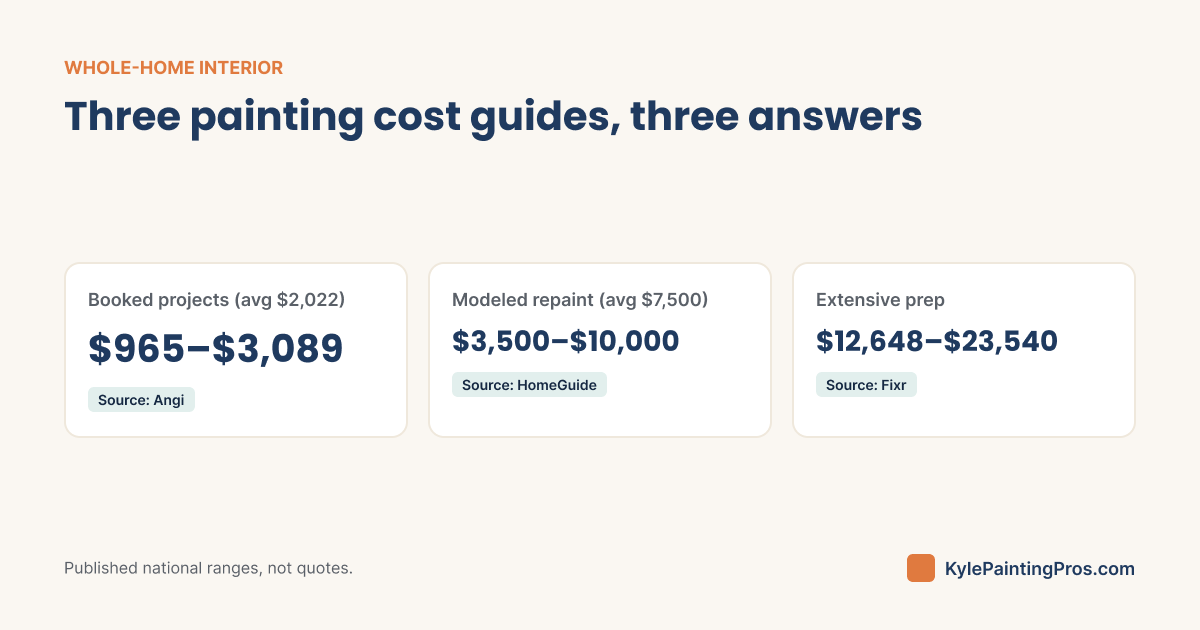
| Source | Whole-home interior figure | What it represents |
|---|---|---|
| Angi | $965 to $3,089, average $2,022 | Costs reported for 65,117 real projects booked by users (2026 data) |
| HomeGuide | $3,500 to $10,000, average $7,500 | A modeled whole-interior repaint |
| Fixr | $12,648 to $23,540 | Whole interior with extensive prep ($5.75 to $10.70 per sq ft of floor) |
For exteriors, Angi reports $1,819 to $4,551 with an average of $3,178 across 39,126 projects, and notes larger or complex jobs can reach about $7,700.
These are all legitimate figures. They disagree because they answer different questions.
Reason 1: Real projects vs. a modeled “whole house”
Angi’s averages come from projects its users actually reported. Those projects include a lot of partial jobs: a few bedrooms, a living room, an accent wall. The average of everything people booked will be lower than the cost of painting every room in a typical house.
HomeGuide and Fixr, by contrast, model a full repaint of a defined house. That is closer to what you would pay if you asked a painter to do the whole interior, but it may not match your job either.
Takeaway: if you are painting a few rooms, project averages like Angi’s are a reasonable sanity check. If you are painting the whole interior, per-square-foot ranges are more useful.
Reason 2: Floor area vs. wall area
Some figures are per square foot of floor, others per square foot of wall or siding surface. A room’s walls usually have more area than its floor. A 12 by 12 foot room with 8-foot ceilings has 144 square feet of floor and 384 square feet of wall (before subtracting openings).
So HomeGuide‘s walls-only figure of $1 to $2 per square foot of wall and its whole-home figure of $3 to $7 per square foot of floor are not contradictory. They are different units.
Reason 3: What counts as “painting”
Scope is the single largest driver. A guide may include or exclude:
- Ceilings
- Trim and baseboards
- Doors and door frames
- Windows and sashes
- Closets
- Primer coats
- Patching, sanding, and caulking
- Moving furniture and protecting floors
Angi itself shows the effect: walls only averages $2.75 per square foot of floor, while walls plus trim and ceilings averages $4.70 (Angi). That is a 70% jump from scope alone.
Reason 4: Prep assumptions
Fixr’s high range assumes significant preparation. Prep is labor-heavy, and labor is already 70% to 85% of an interior painting bill (HomeGuide). A house with smoke staining, water damage, or lots of nail holes can cost far more than a clean, recently painted one of the same size.
Reason 5: Location
National averages hide large regional gaps. Angi’s exterior data alone ranges from a $2,300 average in the Plains region to $4,800 in New England (Angi). Painter wages vary too: the national median is $23.75 per hour according to the U.S. Bureau of Labor Statistics (OEWS, May 2025), and metros sit well above or below that.
Reason 6: Data age and method
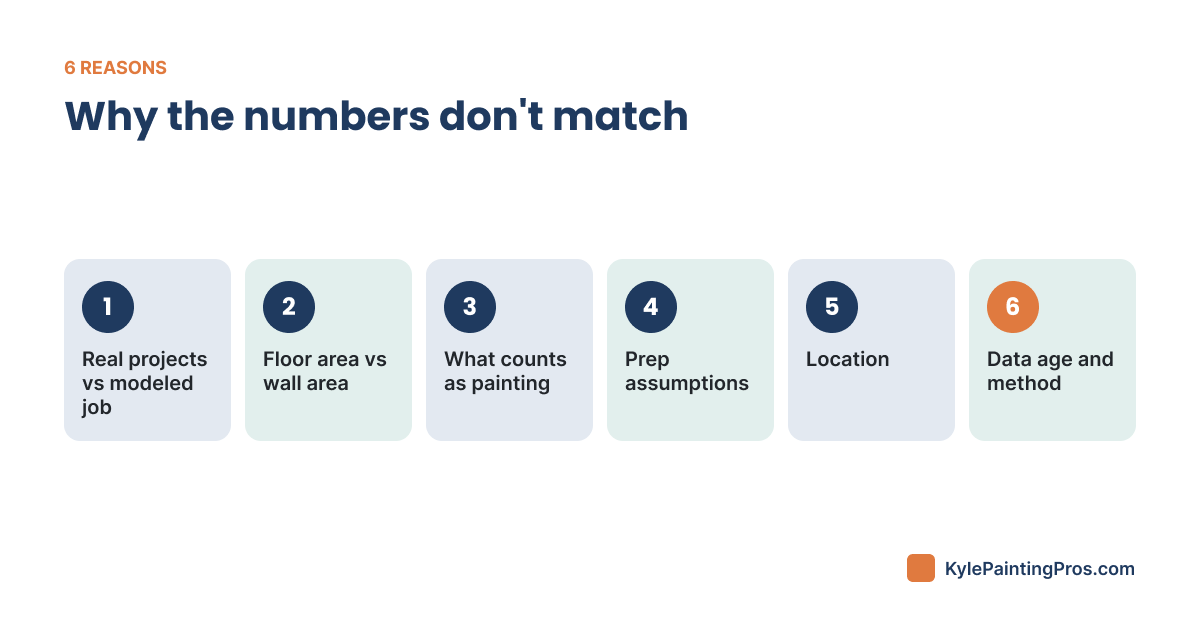
Pages are updated at different times, and some cost pages carry a current-year title on older underlying data. We record both the publish date and the date we accessed each source in our cost methodology.
How to read any painting cost estimate
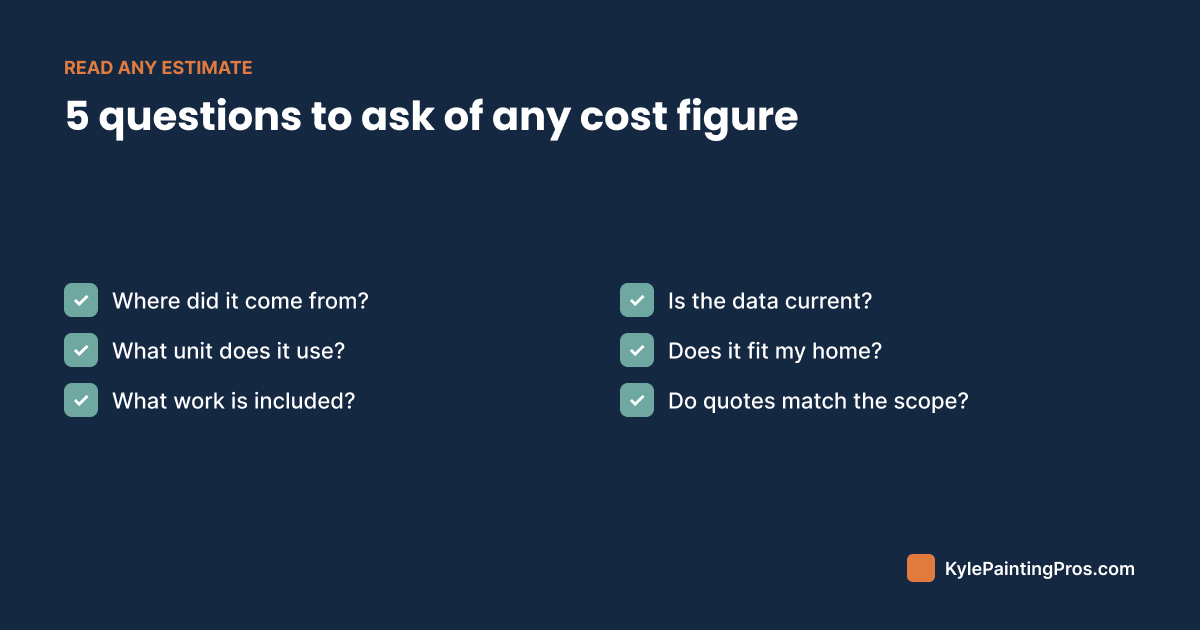
When you see a number, online or in a quote, ask five questions:
- Is it per project, per square foot of floor, per square foot of surface, or per linear foot?
- What surfaces are included? Walls, ceilings, trim, doors?
- How much prep is included? Patching, priming, caulking?
- Are materials included? And which paint quality?
- Where and when does the data come from?
If you cannot answer these, the number is not comparable to anything else.
A better way to budget
Instead of trusting one headline average, build your budget from parts:
- Measure the rooms you want painted.
- Price walls, ceilings, and trim separately using published unit rates, such as $1 to $2 per square foot for walls and ceilings and $1 to $4 per linear foot of trim (HomeGuide).
- Add doors at $75 to $150 each (HomeGuide).
- Adjust up for repairs, texture, or dramatic color changes.
Our Painting Cost Estimator does exactly this and shows its working. If you plan to DIY, use the Paint Calculator to figure out how many gallons you need.
What this means for contractors
If you are a painter, this explains why homeowners sometimes show up with an unrealistic number from a search result. A clear quote that itemizes surfaces, coats, and prep, and states the unit, makes it easy for a customer to see why your price differs from a national average. See how to estimate a painting job for a full approach.
Worked example: one house, three answers
Take a 1,800 square foot home and apply each source’s published method. These are calculations on published rates, not quotes.
| Method | Calculation | Result |
|---|---|---|
| Angi walls only (Angi) | 1,800 x $2.75 | $4,950 |
| Angi walls + trim + ceilings (Angi) | 1,800 x $4.70 | $8,460 |
| HomeGuide whole interior (HomeGuide) | 1,800 x $3 to $7 | $5,400 to $12,600 |
| Fixr with extensive prep (Fixr) | 1,800 x $5.75 to $10.70 | $10,350 to $19,260 |
Same house, a spread of nearly four times between the lowest and highest results. Each one is a fair answer to a different question: walls only, full scope, or full scope with heavy prep. The Angi project average of $2,022 doesn’t appear at all, because it describes the typical booked job, not a full repaint of this house.
Worked example: comparing two quotes
Say you receive two quotes for the same 1,800 square foot home: one for $6,000 and one for $9,000. Before choosing, ask each painter to list surfaces and prep. If the $6,000 quote covers walls only and the $9,000 quote includes ceilings, trim, and doors, they line up closely with Angi’s $2.75 and $4.70 per-square-foot averages (Angi). The cheaper quote isn’t a bargain; it’s a smaller job.
Painting cost guides compared side by side
When you read painting cost guides, it helps to sort each figure into a few columns before comparing them. Doing this once turns a confusing pile of numbers into a clear picture.
- Data type: booked projects, contractor survey, or a modeled job.
- Unit: per project, per square foot of floor, per square foot of wall, per linear foot, or per item.
- Scope: walls only, or walls plus ceilings, trim, doors, and closets.
- Prep: light touch-up, or extensive patching, sanding, and priming.
- Date: when the page was published or updated, and when the data was collected.
Two figures that match on all five columns should be close. Two figures that differ on even one column can be far apart for legitimate reasons. That is the whole idea behind this guide.
A five-question checklist for any cost figure
Use these questions when you meet a new number, whether it comes from a website, a neighbor, or a contractor.
1. Where did the number come from?
Booked-project averages reflect real spending but mix together small and large jobs. Modeled figures reflect a defined job but rely on assumptions. Know which one you are reading.
2. What does it measure?
Check the unit. A per-square-foot figure is meaningless until you know whether it is floor or wall area.
3. What work is included?
Look for a list of surfaces and prep steps. If a guide does not say, assume it may not match your scope.
4. Is it current?
Compare the page title date with the data date. A current-year label does not always mean current data.
5. Does it fit my home?
A national average is a starting point. Your region, your home’s condition, and your scope decide where you land.
Why painting cost guides rarely agree with quotes
Even after you understand the guides, your quotes may still look different. That is expected. A contractor prices your actual walls, your furniture, your access, and their own costs and schedule. Painting cost guides can only describe typical jobs.
The useful question is not whether a quote matches a guide, but whether the gap makes sense. A quote above the national range might be justified by high ceilings, heavy repairs, or a high-cost region. A quote far below the range might be missing scope, such as ceilings, primer, or trim. Ask the contractor to walk you through the line items.
Common mistakes when using painting cost guides
- Comparing a project average with a per-square-foot total. These measure different things, as the headline table shows.
- Mixing floor and wall units. Multiplying a wall-area rate by floor area understates the job.
- Ignoring scope. A walls-only rate applied to a full repaint will come in low.
- Treating one source as the truth. Each source answers a slightly different question, so look at more than one.
- Forgetting regional differences. National figures are blended across very different labor markets.
How we handle disagreement on this site
We do not average conflicting sources into one tidy number, because that would hide the reasons they differ. Instead, our guides show more than one source when they disagree, label each with its unit and scope, and explain the gap. Our painting cost methodology page sets out these rules in full.
To see this approach applied, read the cost to paint a house interior, interior painting cost per square foot, and exterior house painting cost. Each one lays out its sources and explains which figure fits which kind of job.
Painting cost guides compared: a worked side-by-side
Imagine two painting cost guides covering the same interior repaint. One reports a per-project average from real customer jobs. The other reports a per-square-foot rate. To compare them fairly, convert both to the same unit for your home.
- Multiply the per-square-foot rate by your floor area if the guide uses floor area, or by wall area if it uses wall area.
- Check whether the per-project figure includes ceilings, trim, and materials.
- Note the sample size and date of each guide.
Once both numbers describe the same scope and unit, most of the disagreement between painting cost guides usually disappears. What is left is real variation in location, prep, and contractor pricing.
Scope checklist before you trust any painting cost guide
Use this list whenever you read painting cost guides online:
- Surfaces: walls only, or walls plus ceilings, trim, and doors?
- Labor and materials: both included, or labor only?
- Prep: light patching, or full repairs and priming?
- Unit: per project, per room, per square foot of floor, or per square foot of wall?
- Source data: real jobs, contractor surveys, or editorial estimates?
- Date: when were the figures last updated?
If a guide does not answer most of these, treat its numbers as a rough starting point only.
Regional cost caveats
National painting cost guides average out large differences between regions. Painter wages vary by state and metro area, as wage data from the U.S. Bureau of Labor Statistics shows, and that labor gap flows straight into quotes. A national average is a useful anchor, but local quotes are the only reliable number for your home.
When painting cost guides help most and least
Painting cost guides are most useful early, when you are deciding whether a project fits your budget. They are least useful at the end, when you are choosing between two contractors. At that stage, compare itemized quotes for the same scope instead. Our Painting Cost Estimator sits in between: it applies published ranges to your measurements so you can see where a quote lands.
Five reading errors that skew painting cost guides
- Taking the low end of a range as the “real” price.
- Comparing a walls-only figure with a full-scope quote.
- Ignoring the difference between floor area and wall area.
- Assuming a national average applies to every city.
- Forgetting that prep and repairs are often excluded.
Avoiding these mistakes turns painting cost guides from a source of confusion into a practical budgeting tool.
Key takeaways
- Painting cost guides disagree mostly because they measure different scopes and units.
- Before trusting one of the painting cost guides, check its sample size, date, and whether it covers labor and materials.
- Use painting cost guides to set a range, then use local, itemized quotes to set your actual budget.
Before you rely on any of the painting cost guides you find, write down three things about your own project: the surfaces included, the unit being priced, and the condition of the walls or siding. Then read each guide’s fine print and mark where it matches and where it does not. A guide that prices walls only cannot be compared directly with one that bundles ceilings and trim. A range built from national averages will not reflect a crew’s travel time or a home with heavy repairs. This short exercise turns several conflicting painting cost guides into one useful reference point, and it gives you better questions to ask when contractor quotes arrive.
To apply this, compare the ranges in our single-room painting cost guide and per-square-foot interior rates, and read our painting cost methodology to see how we label scope and units. Exterior readers can check the exterior house painting cost ranges.
Painting cost guides: frequently asked questions
Which painting cost guide is most accurate?
None is universally accurate. Each is accurate for its own scope. Angi reflects real booked projects; HomeGuide and Fixr model full repaints with different prep assumptions.
Why is my quote higher than the national average?
Most likely because of scope (ceilings, trim, doors, prep), your region, or a full-house job compared with an average that includes smaller projects.
Should I use cost per square foot?
Yes, but only after confirming whether it is floor area or paintable surface. Read our guide to interior painting cost per square foot.
Is the Angi average wrong?
No. It accurately reflects the projects Angi users reported. It just isn’t the cost of painting an entire home.
Do exterior cost guides disagree too?
Yes, though less dramatically. Angi lists $1 to $3 per square foot for wood siding, while This Old House lists $1.70 to $3.60 (from a search summary we have not re-checked).
What is the single best number to budget with?
Your own measurements times a scope-matched rate. The Painting Cost Estimator does this for you.
Why do painting cost guides show different averages for the same project?
They usually measure different things: one may average real jobs, another may estimate a typical scope, and units can differ between floor area, wall area, and per project.
Which painting cost guides are most reliable?
Guides that state their sample size, date, unit, and scope are the easiest to trust, because you can check whether their numbers match your project.
Should I average several painting cost guides together?
Only if they measure the same scope in the same unit. Averaging a walls-only per-square-foot rate with a full-scope project average produces a number that describes nothing real.
Can painting cost guides replace a quote?
No. They set expectations and help you spot outliers, but only a contractor who sees your home can quote the actual work, including prep, access, and local labor costs.
How old is too old for cost data?
Prices change with wages and materials. Check the date on any figure, and prefer guides that show when they were last updated.
Sources
- Angi, 2026 data, accessed Nov 4, 2026.
- HomeGuide, page titled 2026, accessed Nov 4, 2026.
- Fixr, published Jan 31, 2025 (via secondary citation), accessed Nov 4, 2026.
- Angi, updated Oct 20, 2026, accessed Nov 4, 2026.
- U.S. Bureau of Labor Statistics (OEWS, May 2025).
Notes