
Estimating is where painting businesses make or lose money. Bid too high and you lose the job. Bid too low and you win work that pays less than your crew costs. This guide lays out a repeatable estimating system any painting contractor can use, from the walk-through to the final number, and shows where published market data can help you sanity-check your price. Below, we break down the how to estimate a painting job using published, linked sources.
For homeowner-side price ranges you can sanity-check against, see our interior house painting costs and exterior painting price ranges.
How to estimate a painting job: the formula
Every solid painting estimate comes down to the same structure:
Price = (Labor hours x loaded labor rate) + Materials + Overhead share + Profit
The hard part is getting each piece right. Let’s go through them in order.
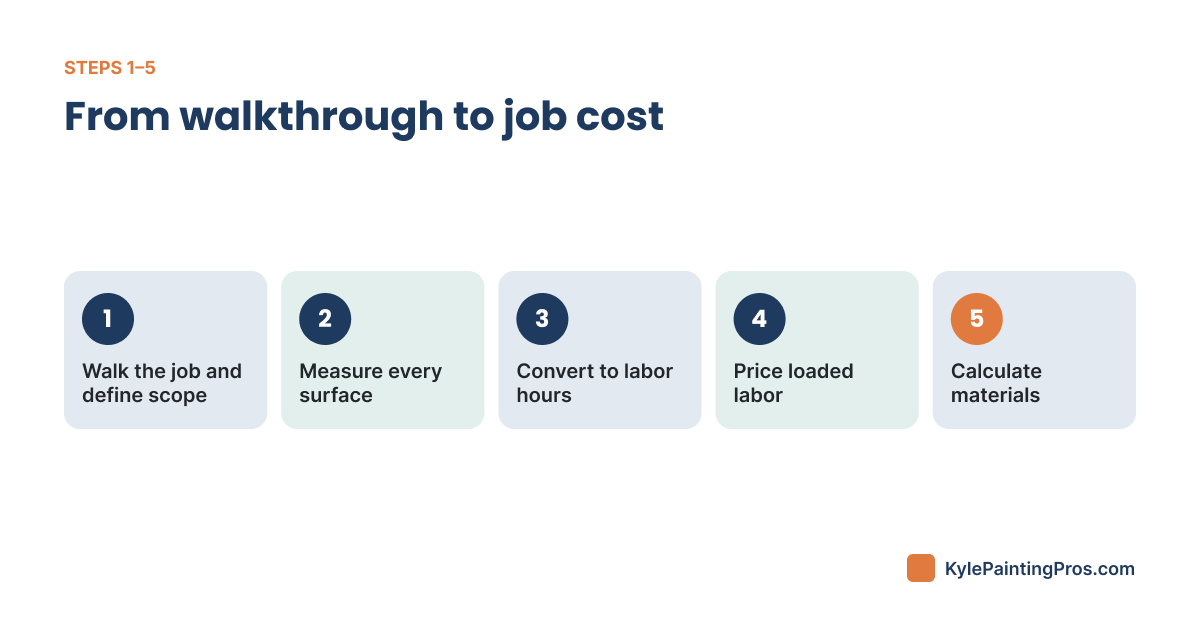
Step 1: Walk the job and define the scope
Before you measure anything, nail down exactly what you are painting. Write down:
- Every room or elevation included
- Surfaces: walls, ceilings, trim, doors, windows, cabinets, siding, soffits
- Number of coats and whether primer is needed
- Color changes, especially dark to light
- Prep: patching, sanding, caulking, scraping, stain blocking
- Access issues: high ceilings, stairwells, multi-story exteriors
- Who moves furniture and protects floors
- Paint product and sheen, and who supplies it
Scope disagreements are the most common source of disputes and lost margin. A written scope protects you and helps the customer compare your bid fairly. Homeowners increasingly arrive with a national average from a website; scope is usually why your number differs (see why painting cost guides disagree).
Step 2: Measure
Measure each surface in the unit you will price it in:
- Walls: perimeter x height, minus openings. A common deduction is about 21 square feet per door and 16 square feet per window (HomeGuide).
- Ceilings: length x width.
- Trim and baseboards: linear feet.
- Doors, windows, cabinet doors: count.
- Exterior siding: wall area by elevation, noting height bands.
Use the Paint Calculator to double-check wall area and paint quantities.
Step 3: Convert measurements into labor hours
Divide each quantity by your production rate, the amount your crew paints per hour on that surface under those conditions. Production rates vary by surface, prep level, coat, tools (brush, roll, or spray), and crew experience.
The best production rates are your own. Track hours by surface on a few jobs and you will quickly have numbers more accurate than any book. Separate rates for:
- Walls, first coat vs. second coat
- Ceilings
- Trim per linear foot
- Doors each
- Prep work (patching, caulking, sanding)
- Setup and cleanup per day
We are building a free, sourced production-rate table; until then, rely on your own job history.
Step 4: Price your labor correctly
Your labor cost is not just the wage. It is the loaded or burdened rate: wage plus payroll taxes, workers’ compensation, unemployment insurance, and any benefits.
For a wage benchmark, the U.S. Bureau of Labor Statistics (OEWS, May 2025) reports a national median of $23.75 per hour and a mean of $26.64 per hour for construction and maintenance painters (May 2025). Wages vary widely by metro area.
On the customer side, HomeGuide lists painter billed rates of $20 to $50 per hour for interior work, and Angi lists $25 to $100 per hour per painter for exterior work. Your billed rate needs to cover your loaded labor cost plus overhead and profit, which is why billed rates sit well above wages.
Step 5: Calculate materials
Materials are the smaller part of a painting job. HomeGuide estimates labor at 70% to 85% of interior painting costs, leaving materials at roughly 15% to 30%. For cabinets, Angi puts labor at 70% to 80%.
To estimate paint:
- Total square feet to paint x number of coats.
- Divide by coverage. Manufacturers and HomeGuide cite up to 400 square feet per gallon per coat; rough, porous, or textured surfaces use more.
- Round up to whole gallons and add primer where needed.
Then price at your supplier cost. Retail references: HomeGuide lists interior paint at $15 to $50 per gallon (noting pros can get significant discounts), and UseCalcPro groups 2026 tiers from about $20 to $35 (economy) to $80 to $110 (premium-plus) for interior and $28 to $45 up to $90 to $120 for exterior.
Don’t forget sundries: tape, plastic, caulk, patching compound, sandpaper, roller covers, and drop cloths.
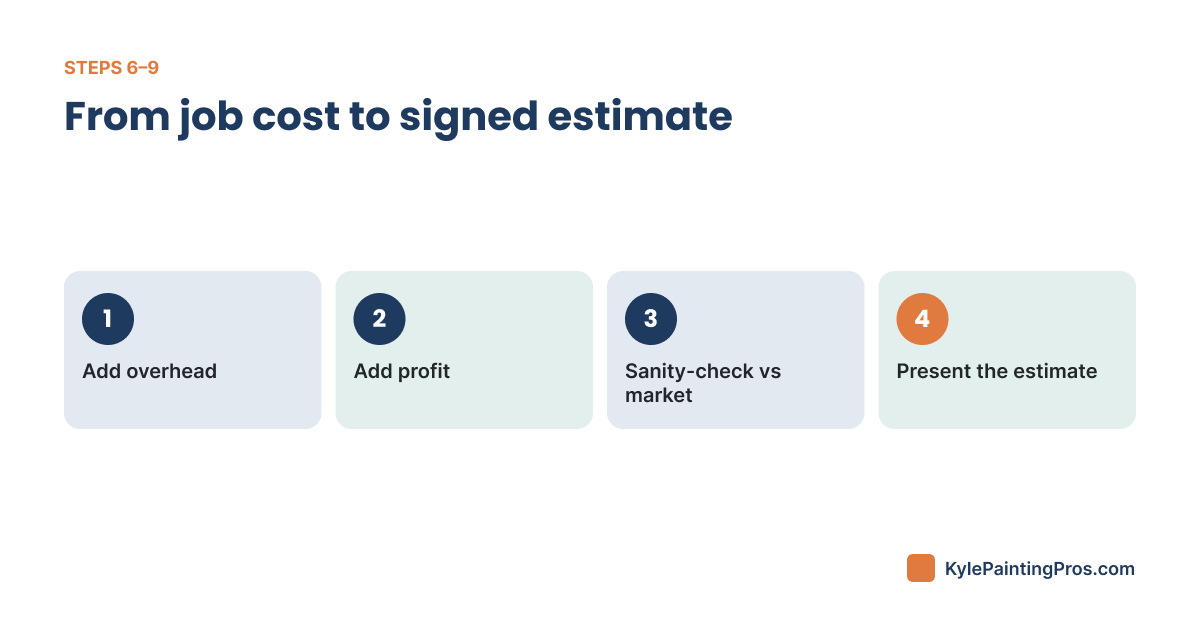
Step 6: Add overhead
Overhead is everything that keeps the business running but isn’t tied to a specific job: vehicle costs, insurance, equipment, software, marketing, office costs, and your own non-production time. A simple approach:
- Total your annual overhead.
- Divide by your expected annual billable labor hours.
- Add that amount per labor hour to every estimate.
Step 7: Add profit
Profit is not optional. It funds growth, slow seasons, and mistakes. Decide whether you calculate it as markup (a percentage added to cost) or margin (a percentage of the final price). They are not the same, and confusing them is one of the most common pricing mistakes. Our guide to markup vs margin explains the math.
Step 8: Sanity-check against the market
Once you have a number, compare it with published ranges so you know how it will land with the customer:
| Job type | Published range | Source |
|---|---|---|
| Interior walls, per sq ft of wall | $1 to $2 | HomeGuide |
| Whole interior, per sq ft of floor | $3 to $7 | HomeGuide |
| Interior project average | $2,022 (range $965 to $3,089) | Angi |
| Exterior, per sq ft of paintable area | $1.50 to $4 | Angi |
| Exterior project average | $3,178 (range $1,819 to $4,551) | Angi |
| Kitchen cabinets, per linear ft | $30 to $70 | HomeGuide |
Being above these ranges isn’t wrong if your scope is bigger or your market is more expensive. But you should know why, and be ready to explain it in the proposal. The Painting Cost Estimator shows a homeowner-facing version of these ranges, which is useful for seeing what your customers see.
Step 9: Present the estimate
A good proposal lists scope, surfaces, coats, product, prep, schedule, payment terms, warranty, and exclusions. Itemizing helps customers compare bids fairly and makes upsells (ceilings, trim, doors) easy to add.
Common mistakes when you estimate a painting job
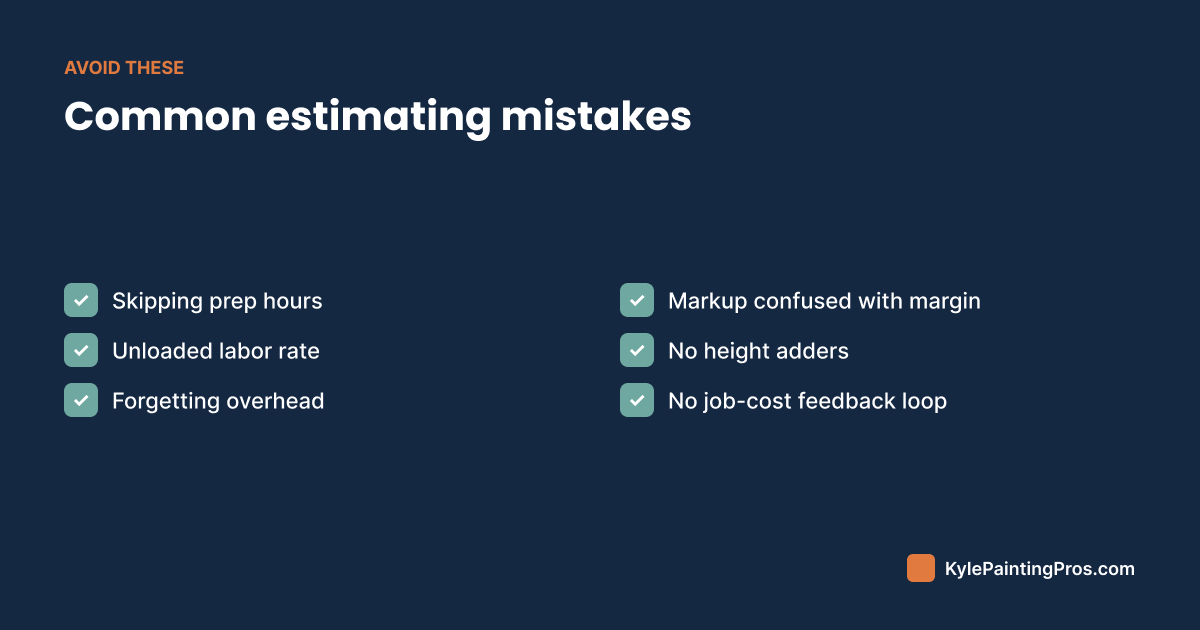
- Pricing labor at the wage instead of the loaded rate
- Forgetting setup, cleanup, and drive time
- Underestimating prep on older homes
- Ignoring height and access on exteriors; Angi lists height adders of 30% above 8 feet up to 120% above 19 feet
- Treating markup and margin as the same thing
- Not tracking actual hours against estimated hours after each job
Build a feedback loop
The best estimators compare every finished job to its estimate. Record estimated vs. actual hours by surface, materials used, and any surprises. After a season, your production rates and overhead numbers will be specific to your crew and market, which is something no published average can give you.
Worked example: building an interior estimate
Here is the structure applied to a hypothetical job. Hours, rates, and overhead below are placeholder inputs to show the math, not benchmarks; use your own numbers.
| Line | Input | Amount |
|---|---|---|
| Labor | 40 hours x $40 loaded rate | $1,600 |
| Materials | 8 gallons x $45 + $120 sundries | $480 |
| Overhead | 40 hours x $15 per hour | $600 |
| Total cost | $2,680 | |
| Price at 25% margin | $2,680 / (1 – 0.25) | $3,573 |
Check the materials share: $480 out of $2,680 is about 18% of cost, which is consistent with HomeGuide‘s 70% to 85% labor share for interior jobs. If your materials share is far outside that, recheck quantities.
Worked example: exterior height adder
If your ground-floor siding takes a given number of hours, Angi suggests labor for areas above 13 feet can run 60% higher. In practice: if a ground-floor wall estimate comes to $1,000 of labor, the same area at second-story height would be priced at about $1,600. Build height into the hours, not as an afterthought.
How to estimate a painting job when the scope is unclear
Not every customer knows what they want painted. Before you can estimate a painting job, you need a scope both of you agree on in writing. A short discovery conversation saves hours of rework later.
- Ask what prompted the project: a sale, a move-in, wear and tear, or a color change. The reason tells you how much prep and finish quality the customer expects.
- Walk each room or elevation together and point at surfaces: “walls, ceiling, trim, doors, closet?” Write down every yes.
- Ask about furniture, pets, working hours, and access, all of which affect your production rate.
- Confirm who supplies paint and which product line, so materials are not double-counted or missing.
If the customer is undecided, quote a base scope and list optional add-ons with their own prices. This keeps the core number clean and lets the customer choose without forcing a full re-estimate.
Building a production-rate library
The most accurate way to estimate a painting job is to use your own production rates, not someone else’s. A production rate is how much of a surface one painter completes per hour, at a given quality and prep level.
What to track
- Surface type: walls, ceilings, trim, doors, cabinets, siding, soffits.
- Unit: square feet for walls and siding, linear feet for trim, each for doors.
- Condition: new, good, fair, or poor, since prep time changes sharply with condition.
- Method: brush and roll, or spray and back-roll.
- Height: standard reach, ladder, or lift.
How to collect it
Have crews log hours by surface on a simple daily sheet. After a few dozen jobs, average the results by category. Revisit the rates every season, because crew experience, equipment, and products change over time.
Estimating software vs spreadsheets
You do not need expensive software to estimate well. A spreadsheet that lists surfaces, quantities, production rates, labor rate, materials, overhead, and target margin will produce consistent numbers. Software helps when you have many estimators, need photos and digital signatures, or want job costing linked to estimates.
Whichever you use, the logic should match the formula at the top of this guide. Our guide to markup vs margin explains the last step, turning cost into price, in more depth.
Presenting the estimate so it wins work
A clear estimate builds trust before the first brush stroke. Strong painting estimates usually include:
- A short summary of the job in plain language.
- A room-by-room or elevation-by-elevation scope list.
- The products, colors (if chosen), sheens, and number of coats.
- Prep steps you will perform, such as patching, caulking, and priming.
- What is excluded, so there are no surprises.
- Price, payment schedule, start window, and warranty terms.
Homeowners often compare your number with online averages. Explaining scope and units up front, as we do in why painting cost guides disagree, makes it easier for them to see why your price fits their job.
Following up and closing the loop
Send the estimate promptly after the walkthrough, then follow up a few days later. If you lose a job, ask why. Price is only one reason; timing, communication, and confidence matter too.
After each completed job, compare estimated hours and materials with actual numbers. That comparison is what turns a rough method into a reliable system for how to estimate a painting job over time.
How to estimate a painting job: a scope checklist for the walkthrough
Use this list on site so nothing is missed when you estimate a painting job:
- Rooms or elevations in scope, plus surfaces in each: walls, ceilings, trim, doors, windows, cabinets, siding, soffits, fascia.
- Surface condition: peeling, cracks, stains, mildew, water damage.
- Height and access: ladders, scaffolding, lifts, stairwells.
- Color changes and number of coats.
- Furniture and contents to move or protect.
- Occupancy and working-hour limits.
- Age of the home and lead-safe requirements. For homes built before 1978, the EPA RRP rule applies to many painting jobs that disturb paint.
Five estimating errors and how to fix them
- Pricing from floor area alone. Measure wall area and trim length so labor matches the real surface.
- Using someone else’s production rates. Build your own from job logs.
- Forgetting non-painting time. Setup, masking, cleanup, and travel are real hours.
- Hiding overhead in markup. Calculate overhead per production hour, then add margin.
- No contingency for unknowns. Note exclusions and price change orders in writing.
Fixing these is the fastest way to estimate a painting job that wins work and still makes money.
Regional pricing caveats
Labor costs differ widely across the country. The U.S. Bureau of Labor Statistics publishes painter wages by state and metro area, which is a useful check on your own loaded labor rate. National averages from cost guides are a sanity check, not a target, when you estimate a painting job in your market.
Estimating interior vs exterior jobs
Interior estimates are driven by wall area, ceilings, trim, and how full the home is. Exterior estimates add weather risk, height, siding type, and heavier prep such as washing and scraping. Keep separate production rates for each, because a rate that is accurate for interior walls will be wrong for siding.
How to estimate a painting job for a first-time customer
New customers often have no idea what painting costs, so the estimate is also an education. Walk them through the scope room by room, show which surfaces are included, and explain why prep matters. When you estimate a painting job this way, the customer sees value before they see the price.
How to estimate a painting job with photos or video
Remote estimates can save a trip for small jobs, but they miss condition details. If you estimate a painting job from photos, ask for wide shots of every wall, close-ups of damage, and the ceiling height. State in writing that the price is subject to an on-site check, and confirm before the start date.
Key takeaways
- How to estimate a painting job comes down to scope, measurement, production rates, and honest overhead.
- Track actual hours against estimates; that feedback loop is how to estimate a painting job more accurately over time.
- Present scope clearly so customers understand the number, not just the price.
A final check on how to estimate a painting job is to read the estimate as the customer will. Does it name every surface, the number of coats, the products, the prep steps and what is excluded? Clear line items reduce disputes, and they make it easier to compare the estimate with the actual hours once the job is done. Learning how to estimate a painting job accurately is an ongoing process: track your production rates on each job, update them every season, and your next estimate will be closer to the real cost.
Turn your estimate into a price with our guide to markup vs margin pricing, and explain market ranges to clients using why painting cost guides disagree. The Paint Calculator speeds up material counts.
How to estimate a painting job: FAQs
Should I estimate by the hour or by the square foot?
Estimate by hours internally, since that’s what you pay for. Present by scope and total to the customer. Per-square-foot quotes are easy to compare but hide the real drivers.
How do I estimate faster without losing accuracy?
Build a template with your own production rates by surface, a fixed loaded labor rate, and an overhead rate per hour. Update them each season from actual job data.
What should I do if my price is far above the online averages?
Itemize. Show surfaces, coats, prep, and product. The customer then sees scope, not just a number. Point them to the Painting Cost Estimator so they can compare like with like.
How long should it take to estimate a painting job?
Small interior jobs can often be measured and priced in a single visit. Larger or exterior jobs take longer because of access, prep, and condition checks. Accuracy matters more than speed.
Should I include a contingency in my painting estimate?
Many estimators list exclusions and price unknowns as change orders rather than padding the price. Either way, explain your approach in writing so the customer understands it.
What is the first step in how to estimate a painting job?
Define the scope. Measurements, labor, and materials all depend on knowing exactly which surfaces you will paint and how much prep they need.
Can software tell me how to estimate a painting job?
Software organizes the math, but it relies on your production rates, labor cost, and overhead. Accurate inputs matter more than the tool.
How to estimate a painting job when the walls are in poor condition?
Inspect closely and price repairs as a separate line. Patching, sanding, and priming can take longer than painting, so list them clearly to avoid disputes later.
Sources
- HomeGuide, accessed Nov 4, 2026.
- HomeGuide, accessed Nov 4, 2026.
- Angi and Angi, 2026 data, accessed Nov 4, 2026.
- Angi, updated Oct 20, 2026, accessed Nov 4, 2026.
- UseCalcPro (secondary aggregator), accessed Nov 4, 2026.
- U.S. Bureau of Labor Statistics (OEWS, May 2025), May 2025.
Notes