
Two painting contractors can both say they “add 30%” and end up with very different businesses. One means a 30% markup on cost. The other means a 30% profit margin on the price. That difference decides whether your jobs fund your company or just keep your crew busy. This guide explains the math, shows how to convert between the two, and gives you a pricing workflow you can apply to every estimate. Below, we break down the how to price painting jobs using published, linked sources.
This guide pairs with our step-by-step painting estimate system, which builds the costs you will price here.
The definitions
Markup is how much you add to your cost, expressed as a percentage of cost.
Markup % = (Price – Cost) / Cost
Margin is how much of the final price is left after cost, expressed as a percentage of price.
Margin % = (Price – Cost) / Price
Same dollars of profit, different denominators. Because price is always larger than cost, the margin percentage is always smaller than the markup percentage for the same job.
A simple example
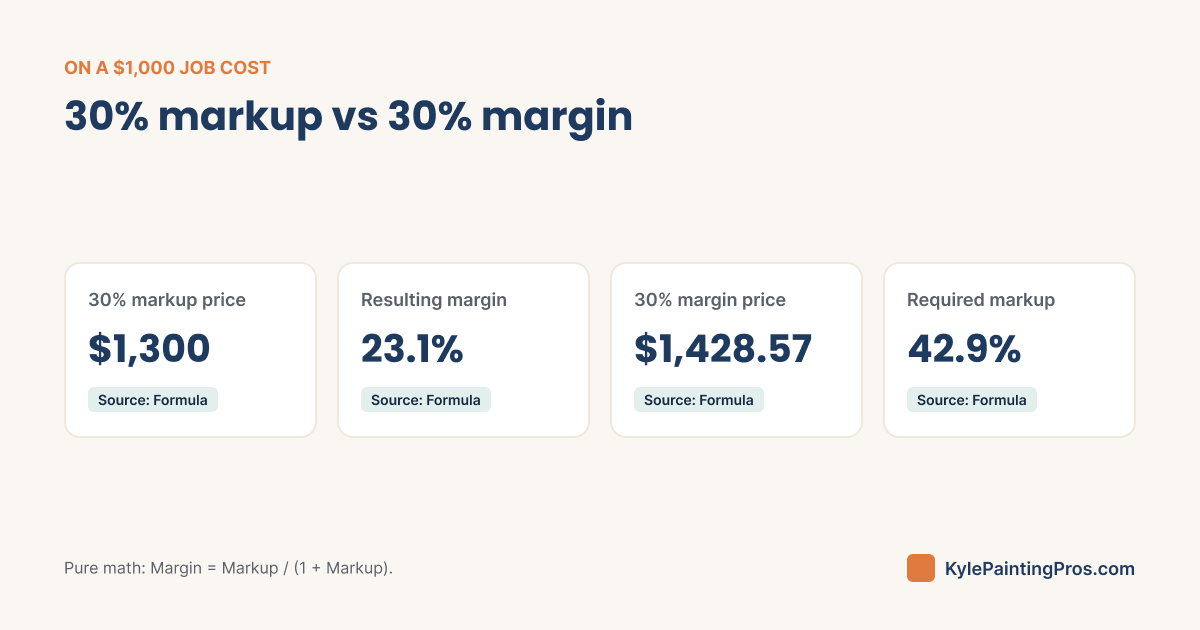
Suppose a job’s total cost (labor, materials, and overhead) is $1,000.
- Add a 30% markup: price = $1,000 x 1.30 = $1,300. Profit is $300. Margin is $300 / $1,300 = 23.1%.
- Target a 30% margin: price = $1,000 / (1 – 0.30) = $1,428.57. Profit is $428.57. Markup is $428.57 / $1,000 = 42.9%.
On a single $1,000 job the gap is about $129. Across a full season of jobs, it can be the difference between a profitable year and a break-even one.
The conversion formulas
Margin = Markup / (1 + Markup)
Markup = Margin / (1 – Margin)
Price from a target margin = Cost / (1 – Margin)
Markup to margin conversion table
| Markup on cost | Resulting margin |
|---|---|
| 10% | 9.1% |
| 20% | 16.7% |
| 25% | 20.0% |
| 30% | 23.1% |
| 40% | 28.6% |
| 50% | 33.3% |
| 67% | 40.1% |
| 100% | 50.0% |
| Target margin | Required markup |
|---|---|
| 10% | 11.1% |
| 20% | 25.0% |
| 25% | 33.3% |
| 30% | 42.9% |
| 40% | 66.7% |
| 50% | 100.0% |
These are pure math, so they apply to any business. Pin this table near your estimating desk.
Why margin is the better target
Most business planning works on margin. Your income statement shows revenue, then costs, then what’s left as a share of revenue. If you plan on a 25% gross margin but price with a 25% markup, you will actually earn 20%, and the shortfall will show up as a mystery at year end.
Margin also makes discounting visible. If a customer asks for 10% off a job priced at a 25% margin, you are giving away 40% of your gross profit on that job.
What goes into “cost”
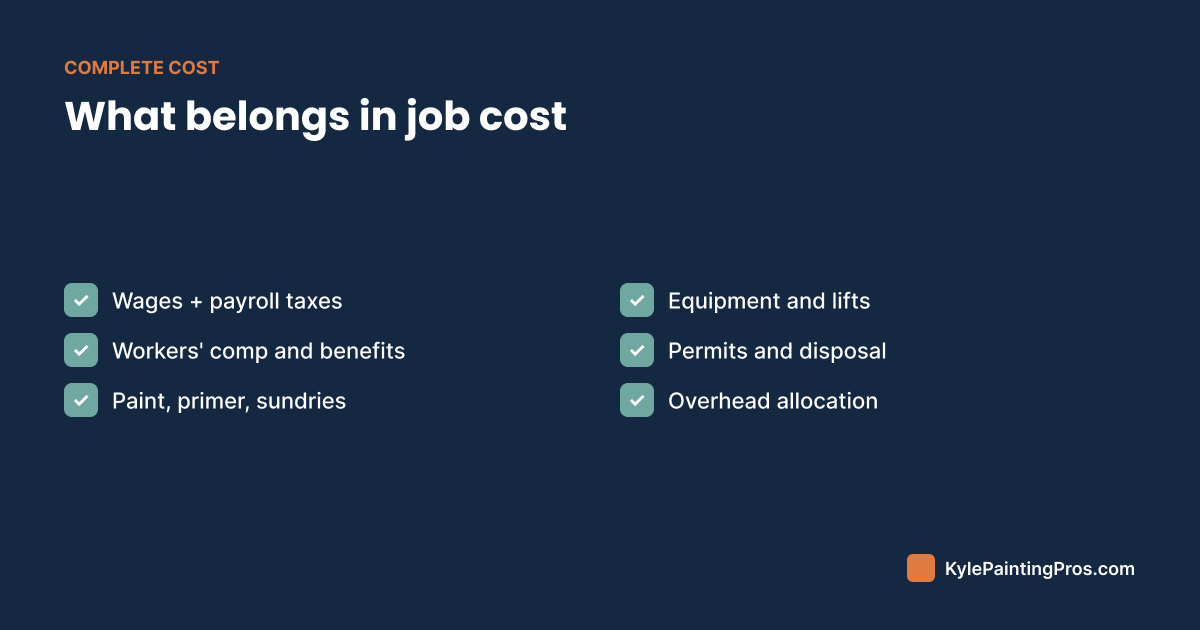
Markup and margin only work if cost is complete. For a painting job, cost should include:
- Loaded labor: wages plus payroll taxes, workers’ compensation, and benefits. For a wage benchmark, the U.S. Bureau of Labor Statistics (OEWS, May 2025) reports a national median of $23.75 per hour for construction and maintenance painters (May 2025); your loaded cost is higher.
- Materials: paint, primer, and sundries at your actual supplier cost.
- Job-specific costs: equipment rental, lifts, permits, disposal.
- Overhead allocation: a share of vehicles, insurance, office, marketing, and your non-production time.
Some contractors apply markup only to direct costs and recover overhead through the markup. That works, but only if the markup is sized to cover overhead and profit together. Be explicit about which approach you use.
How to price painting jobs: a step-by-step workflow
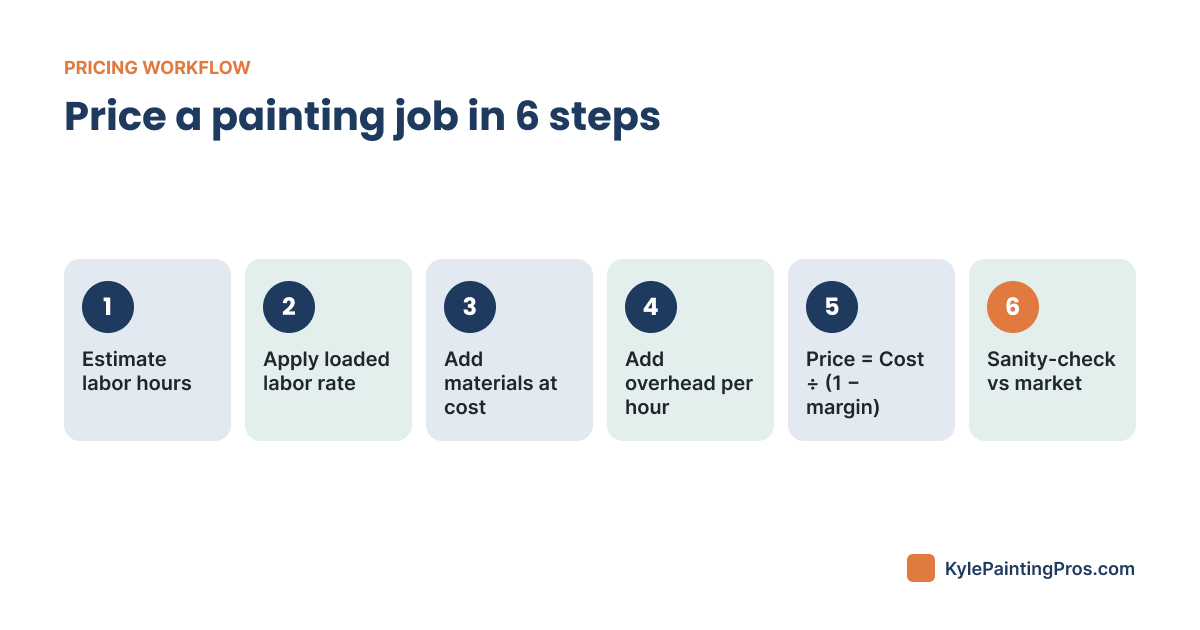
- Estimate labor hours by surface, using your own tracked production rates. See how to estimate a painting job.
- Multiply by your loaded labor rate.
- Add materials at cost.
- Add overhead per labor hour (annual overhead / annual billable hours).
- Set price with Price = Total cost / (1 – target margin).
- Sanity-check against market data so you know how the number will land.
Sanity-checking against the market
Customers often compare your quote with published national figures. It helps to know them:
- Interior painter billed rates: $20 to $50 per hour (HomeGuide)
- Exterior painter labor: $25 to $100 per hour (Angi)
- Interior labor share: 70% to 85% of the job (HomeGuide)
- Average interior project: $2,022; average exterior project: $3,178 (Angi, Angi)
If your price is well above these, make sure the proposal explains why: scope, prep, product, warranty, or local costs. Homeowners can run their own numbers in our Painting Cost Estimator, so it pays to understand what it will show them.
Common mistakes in how to price painting jobs
- Confusing markup with margin. Covered above, and the most expensive mistake on this list.
- Using wages instead of loaded labor cost.
- Forgetting non-billable time: estimating, driving, supply runs, and callbacks.
- Discounting without recalculating margin.
- Pricing to match the lowest bid instead of to your own costs.
- Never reviewing actual vs. estimated after the job.
Worked example: the cost of a discount
A job costs you $3,000 and you price it at a 25% margin: $3,000 / 0.75 = $4,000, with $1,000 gross profit. The customer asks for 10% off, so the price drops to $3,600. Your profit falls to $600, a 40% cut, while your costs stay exactly the same. The margin is now 16.7%. Before you discount, know this number.
Worked example: materials vs labor markups
Some contractors mark up materials less than labor. Using placeholder inputs: labor cost $2,000 marked up 50% = $3,000; materials $500 marked up 20% = $600. Price: $3,600. Total cost: $2,500. Blended margin: $1,100 / $3,600 = 30.6%. Always check the blended result against your target.
Worked example: overhead hidden in markup
If your overhead equals 15% of revenue and you want 10% net profit, your gross margin on direct costs needs to be about 25%. That requires a 33.3% markup on direct costs, not 25%.
How to price painting jobs from your overhead up
Many painters set prices by copying competitors. A sturdier approach is to work out what each production hour must cover before profit, then add margin on top. This section shows the logic without inventing numbers for your business.
Step 1: Total your annual overhead
List every cost that is not tied to a single job: insurance, vehicles, fuel, software, phones, marketing, office rent, accounting, licenses, equipment replacement, and the owner’s non-production time. Use last year’s books where you can.
Step 2: Estimate billable production hours
Count the hours your crews actually spend painting on paid jobs in a year. Remove holidays, weather days, travel, estimating, and slow seasons. This number is almost always lower than people expect.
Step 3: Divide overhead by billable hours
The result is your overhead cost per production hour. Add it to your loaded labor cost per hour, and you have the true cost of one hour on site before materials and profit.
Step 4: Apply your target margin
Use the margin formula in this guide to convert that cost into a selling price. Because the overhead is already counted, your margin is real profit, not overhead in disguise.
Discounts, deposits, and payment terms
Pricing does not stop at the number on the quote. How you structure payment affects cash flow and risk.
- Discounts: as the worked example in this guide shows, a small discount removes a large share of profit. Offer scope reductions instead of price cuts when you can.
- Deposits: many contractors take a deposit to secure the schedule and buy materials. Check your state’s rules, since some limit deposit amounts for home improvement work.
- Progress payments: large jobs can be billed in stages so you are not financing the whole project.
- Change orders: price extra work in writing before you do it, using the same markup-vs-margin logic.
Communicating price to customers
Customers rarely care about your markup. They care about what they get and whether they trust you. Present prices with a clear scope, product list, and warranty rather than a breakdown of your profit. If a customer compares you with an online average, point to the scope differences explained in our guide to why painting cost guides disagree.
A quarterly pricing review
Prices go stale as wages, materials, and overhead change. Every quarter, check:
- Actual vs estimated hours on recent jobs.
- Material costs vs what you assumed.
- Achieved gross margin by job type.
- Win rate on quotes sent.
- Overhead changes, such as new vehicles or insurance renewals.
If margin is slipping, adjust production rates or prices before the gap grows. If your win rate is very high, it may be a sign you are underpriced.
Tools to put this into practice
Use our guide to estimating a painting job to build accurate costs, then apply the margin math from this page. The Painting Cost Estimator gives a homeowner-side view of typical totals, and our painting cost methodology explains how those published ranges are labeled. Learning how to price painting jobs well is a habit, not a one-time calculation.
How to price painting jobs: a cost checklist
You cannot set a profitable price until every cost is counted. Use this checklist before you apply markup or margin.
- Direct labor: wages for the hours on the job.
- Labor burden: payroll taxes, workers’ compensation, and benefits.
- Materials: paint, primer, caulk, tape, plastic, and sundries.
- Equipment: rentals such as lifts or sprayers, plus wear on owned gear.
- Job-specific costs: permits, dumpster fees, lead-safe supplies.
- Overhead share: your overhead per production hour multiplied by job hours.
Once these are added up, you know the true job cost. Only then does it make sense to decide how to price painting jobs with a margin target.
Worked example: one job priced two ways
Imagine a job where the total cost, including overhead, comes to a round number. One estimator adds a 30% markup. Another targets a 30% margin. Using the formulas in this guide, the margin target produces a higher price, because margin is measured on the selling price rather than on cost. The difference is the profit the first estimator thought they were earning but never did. Run this comparison once with your own numbers, and you will see why learning how to price painting jobs on margin protects your business.
Labor rate checks
Your labor cost is the biggest input. The U.S. Bureau of Labor Statistics publishes painter wages by state and metro area, which helps you check that your wage assumptions are realistic for your market. Remember to add labor burden on top of the wage; the hourly wage alone understates true labor cost.
Regional pricing caveats
Prices that work in one market can fail in another. Wages, insurance, fuel, and customer expectations all vary by region. National homeowner cost guides such as HomeGuide and Angi are helpful as a sanity check, but your own cost data should drive how to price painting jobs locally.
Pricing by job type
- Interior repaints: price by surface and production rate; furniture and occupancy affect speed.
- Exterior repaints: add height, access, weather risk, and heavier prep.
- Cabinets: detailed, multi-step work; track hours per door and drawer.
- Commercial: often bid against specifications, with stricter schedules and insurance requirements.
Each job type should carry its own production rates, even if your margin target stays the same.
Common mistakes in how to price painting jobs
- Treating markup and margin as the same number.
- Leaving out labor burden.
- Forgetting overhead on small jobs.
- Discounting instead of trimming scope.
- Never comparing estimated hours with actual hours.
Fixing these is the heart of how to price painting jobs that keep the business healthy.
How to price painting jobs when costs rise
Wages, insurance, and materials rarely stay still. When your costs go up, your margin shrinks unless prices follow. Review your overhead and labor rates whenever a major cost changes, and update your estimating spreadsheet so new quotes reflect current costs. For jobs already sold, consider adding a materials escalation clause to long-lead contracts. Knowing how to price painting jobs means updating your numbers as often as your costs change, not just once a year.
Key takeaways
- How to price painting jobs well starts with knowing your full cost, including overhead per production hour.
- Set targets in margin, then convert to markup, so your quotes deliver the profit you expect.
- Review pricing quarterly; how to price painting jobs is an ongoing habit, not a one-time calculation.
When you decide how to price painting jobs, test your number against the job before you send it. Check that the price covers labor at your real crew cost, materials with waste, overhead such as insurance and vehicles, and the profit margin you planned, not just a markup. Compare the result with past jobs of a similar size and scope to see if it falls in a sensible range for your market. If it looks too high, review the scope rather than cutting margin first. Keeping a record of estimated and actual hours on each job is the most reliable way to improve how to price painting jobs over time.
Build accurate costs first with how to estimate a painting job, then compare your prices with homeowner-side ranges in our interior house painting cost guide and exterior painting costs.
How to price painting jobs: FAQs
What is a good profit margin for a painting business?
We have not yet found a reliable published benchmark for painting contractor margins, so we don’t quote one. We are planning a contractor survey and will publish results with sample size and method.
Is a 50% markup the same as a 50% margin?
No. A 50% markup produces a 33.3% margin. A 50% margin requires a 100% markup.
Should I mark up materials separately?
Many contractors do, often at a different rate from labor. Whatever you choose, apply it consistently and make sure the final job margin hits your target.
Should I show markup on the customer’s quote?
Most contractors don’t. Present scope, materials, and a total. Itemize surfaces so the customer understands the value.
How often should I review my pricing?
At least once a season, and whenever wages, insurance, or material costs change. Compare actual job margins with your targets.
Do national averages help with pricing?
Only as a reality check. Your costs set your price; published ranges such as $20 to $50 per hour for interior painters (HomeGuide) show what customers have seen online.
Is a higher margin always better?
Not if it costs you the work. A margin target should cover overhead, risk, and growth while staying competitive in your market. Track your win rate alongside margin: if you win nearly every bid, your price may be too low; if you win very few, check whether scope, presentation, or price is the problem. Reviewing both numbers each quarter keeps pricing grounded in real results rather than guesses.
What is the difference between markup and margin when I price painting jobs?
Markup is profit as a percentage of cost. Margin is profit as a percentage of the selling price. The same dollar profit gives a higher markup percentage than margin percentage.
Should I price painting jobs by the hour or by the job?
Many contractors estimate in hours but present a fixed job price. Customers like a clear total, and you keep control of your production rates and margin.
How do I price painting jobs for repeat customers?
Use the same cost and margin math. If you want to reward loyalty, offer added value such as a free touch-up visit rather than a lower margin.
How do I know if my prices are too low?
Signs include winning nearly every bid, consistently going over estimated hours, and low profit at year end even with a full schedule.
Should I price painting jobs differently for commercial work?
The cost and margin math is the same, but commercial bids often include stricter schedules, insurance requirements, and specifications. Build those costs in before applying your margin.
Sources
- U.S. Bureau of Labor Statistics (OEWS, May 2025), May 2025.
- HomeGuide, accessed Nov 4, 2026.
- Angi and Angi, accessed Nov 4, 2026.
Notes