
Ask three cost websites what it costs to paint the inside of a house and you can get three answers that are thousands of dollars apart. That is not because one of them is lying. It is because they measure different things. This guide pulls the published figures together, shows you exactly where each number comes from, and explains how to turn them into a realistic budget for your own home. Below, we break down the cost to paint house interior using published, linked sources.
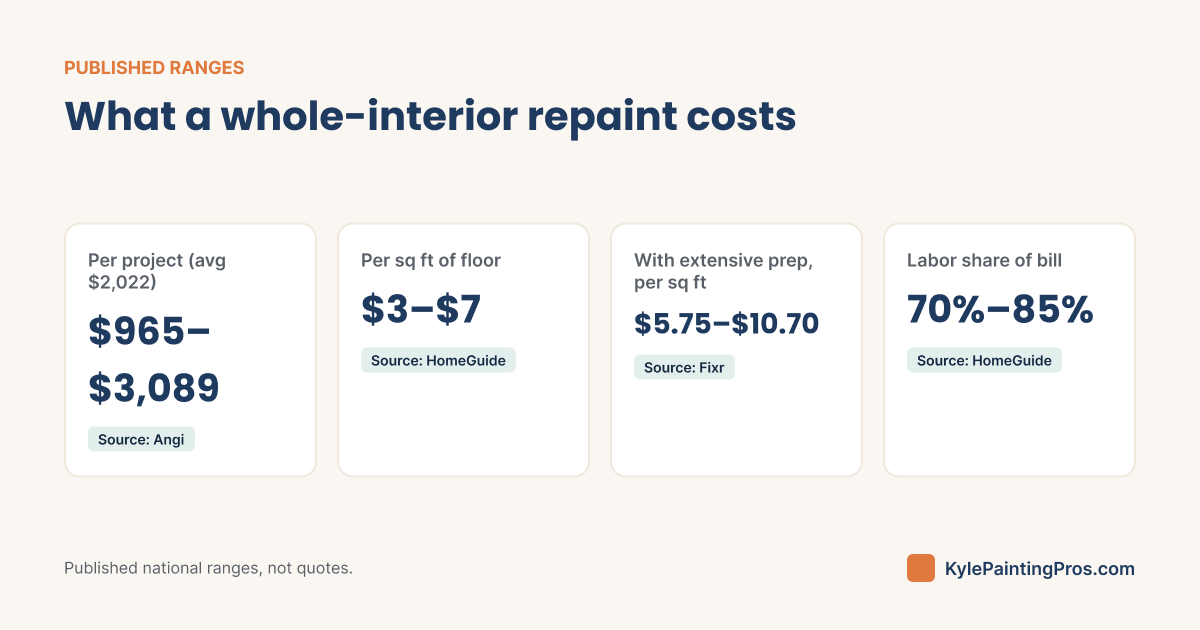
Quick answer: Angi reports that homeowners paid between $965 and $3,089 to paint a home interior, with an average of $2,022, based on 65,117 verified projects in its 2026 data. HomeGuide puts a whole interior at $3 to $7 per square foot of floor area, and Fixr publishes a much higher $5.75 to $10.70 per square foot when extensive prep is included. Your number depends mostly on scope: walls only, or walls plus ceilings, trim, and doors.
Cost to paint house interior: prices at a glance
| What you are pricing | Published range | Source |
|---|---|---|
| Whole interior (per project) | $965 to $3,089 (average $2,022) | Angi |
| Whole interior (per sq ft of floor) | $3 to $7 | HomeGuide |
| Whole interior, walls only (per sq ft of floor) | $2.75 average | Angi |
| Whole interior, walls + trim + ceilings (per sq ft of floor) | $4.70 average | Angi |
| Walls only (per sq ft of wall surface) | $1 to $2 | HomeGuide |
| Ceilings (per sq ft) | $1 to $2 | HomeGuide |
| Trim (per linear ft) | $1 to $4 | HomeGuide |
| Interior door (each) | $75 to $150 | HomeGuide |
| Average bedroom | $350 to $850 | HomeGuide |
| Painter hourly rate | $20 to $50 per painter-hour | HomeGuide |
| Typical job minimum | $250 to $500 | HomeGuide |
All figures are as published by the named source and include labor and materials unless noted. See our cost methodology for how we collect, label, and update these numbers.
Why “per square foot” means two different things
The single biggest source of confusion in painting prices is the unit. Some guides quote cost per square foot of floor area, which is what you know from your listing or appraisal. Others quote per square foot of paintable surface, which is the wall area you actually roll paint onto.
A room’s wall surface is usually much larger than its floor. A 12 by 12 foot bedroom has 144 square feet of floor, but with 8-foot ceilings its four walls measure 384 square feet before you subtract doors and windows (4 walls x 12 ft x 8 ft). So a $1.50 per square foot wall price and a $4.70 per square foot floor price can describe very similar jobs. Always check which unit a quote or guide is using before you compare.
What drives the price up or down
1. Scope: what gets painted
Walls are the bulk of the area, but ceilings, trim, doors, and windows take much more labor per square foot because of cutting in and detail work. Angi’s own figures show this clearly: its walls-only average is $2.75 per square foot of floor, while walls plus trim and ceilings averages $4.70 (Angi). If you only need walls repainted in the same color, ask for a walls-only quote.
2. Labor
Labor is the largest part of almost every painting bill. HomeGuide estimates labor at 70% to 85% of the total cost of interior painting. That is why the hourly rate, crew efficiency, and the amount of prep matter far more than which brand of paint you choose. For context on wages, the U.S. Bureau of Labor Statistics (OEWS, May 2025) reports a national median of $23.75 per hour for construction and maintenance painters. A contractor’s billed rate is higher than the wage because it also covers payroll taxes, insurance, equipment, vehicles, overhead, and profit.
3. Prep and repairs
Patching holes, sanding glossy surfaces, caulking gaps, priming stains, and moving furniture all take time. This is the main reason Fixr reports much higher per-square-foot numbers: its range assumes more preparation. If your walls have water stains, smoke damage, or heavy patching, budget toward the top of the published ranges.
4. Texture and ceiling height
Textured walls hold more paint and take longer to cover. HomeGuide lists a texture add-on of $0.80 to $2.00 per square foot. High ceilings and stairwells need ladders or scaffolding, which slows the crew down.
5. Color changes
Going from a dark color to a light one, or covering a bold accent wall, often needs a primer coat plus two finish coats. Two coats is the standard assumption in most estimates, including our Paint Calculator.
6. Paint quality
Paint matters less to the total than people expect because labor dominates, but it is still a real line item. HomeGuide lists interior paint at roughly $15 to $50 per gallon and primer at $10 to $30 per gallon, and notes that contractors often buy at a discount. A secondary aggregator, UseCalcPro, groups 2026 interior paint into tiers from about $20 to $35 (economy) to $55 to $80 (premium) per gallon.
How to estimate your own interior job
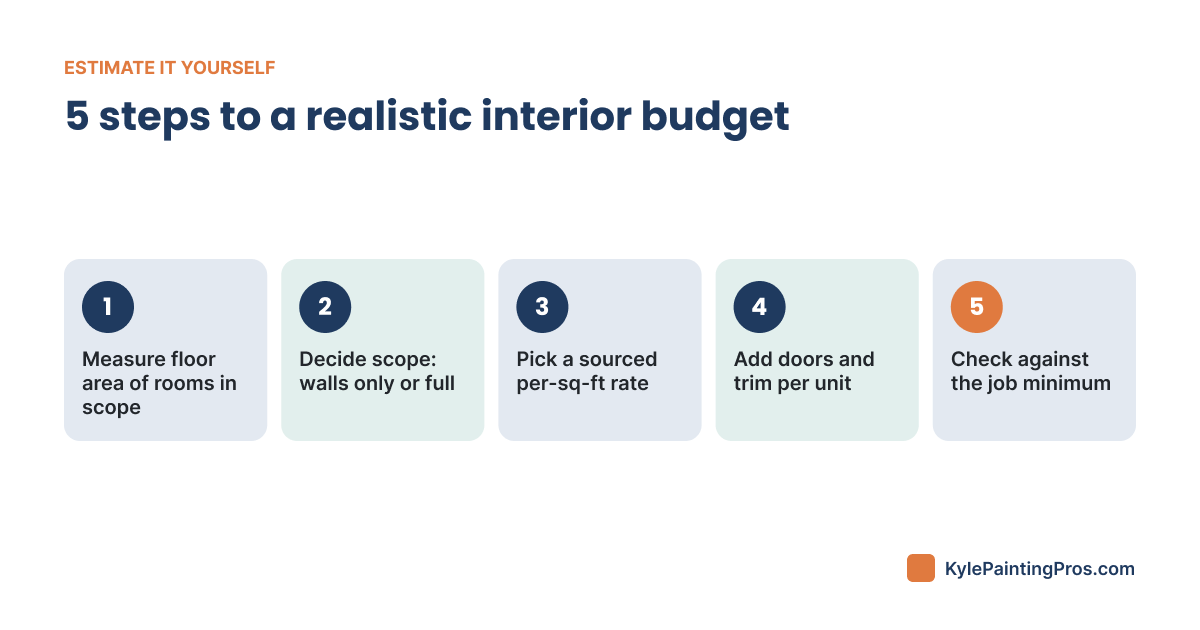
You do not need a contractor to get a sensible ballpark. Here is the method we recommend:
- Measure your floor area for the rooms you want painted, or use your home’s listed square footage for a whole-house job.
- Decide on scope: walls only, or walls plus ceilings and trim.
- Pick a per-square-foot rate from the table above that matches your scope. Use the low end for empty rooms with smooth walls in good condition, the high end for occupied rooms, repairs, or color changes.
- Add specific items priced per unit: doors at $75 to $150 each and trim at $1 to $4 per linear foot (HomeGuide).
- Check against the job minimum. Very small jobs often hit a $250 to $500 floor (HomeGuide).
Our Painting Cost Estimator runs this math for you and shows its working, and the Paint Calculator tells you how many gallons to buy if you plan to do it yourself.
A worked example
Take a 1,500 square foot home, walls plus trim and ceilings. At Angi’s published $4.70 average per square foot of floor, the estimate is about $7,050. At HomeGuide’s $3 to $7 range, the same home lands between $4,500 and $10,500. These are simple multiplications of published rates, not quotes. Notice that this is well above Angi’s $2,022 per-project average: that average reflects the mix of jobs Angi users actually booked, many of which are smaller than a full interior. We explain this gap in Why Painting Cost Guides Disagree.
Cost to paint house interior by room
Bedrooms are the most common single-room job. HomeGuide puts an average bedroom at $350 to $850. Kitchens and bathrooms have less open wall but more cutting in around cabinets and fixtures, so they cost more per square foot of wall. For room-by-room detail, see our guide to the cost to paint a room.
DIY vs hiring a painter
Because labor is 70% to 85% of the bill (HomeGuide), doing it yourself saves most of the cost. Your out-of-pocket costs are paint, primer, and supplies. To estimate paint, divide your wall area by the coverage on the can, typically up to 400 square feet per gallon per coat (HomeGuide), then multiply by two coats. The paint quantity guide walks through this.
What you give up is time and finish quality. Professionals cut clean lines quickly, own sprayers and ladders, and usually warranty their work. For high ceilings, stairwells, or full-house jobs, many homeowners split the difference: they paint bedrooms themselves and hire out the tall or detailed areas.
How to get an accurate cost to paint house interior quote
- Get at least three written quotes that list the same scope: rooms, surfaces, number of coats, and prep.
- Ask whether the price includes paint, and which product and sheen.
- Confirm who moves furniture and who handles patching.
- Ask about insurance and any warranty on the work.
- Compare quotes using the same unit. Convert everything to a total, not a per-square-foot rate on different bases.
Cost to paint house interior: a room-by-room planning checklist
Before you collect quotes, walk the house with a notepad. A written scope is the single best tool for keeping the cost to paint house interior work predictable, because every painter will then price the same job.
- List every room you want painted, plus hallways, stairwells, and closets. Closets are easy to forget and painters often price them separately.
- For each room, mark which surfaces are in scope: walls, ceiling, baseboards, door casings, window casings, doors, and crown molding.
- Note the current color and the new color. Flag any change from dark to light, or any strong accent color going on or coming off.
- Note damage: nail holes, cracks at corners, water stains, peeling patches, and old anchors from shelves or TVs.
- Note ceiling height. Anything above a standard height, and any stairwell, should be called out so it is not a surprise later.
- Note what must be moved. Pianos, aquariums, built-in media units, and heavy beds can change the labor estimate.
Once you have this list, you can price it two ways: by applying the published per-square-foot rates in the table above, or by asking contractors to quote it line by line. Ideally do both and compare.
Planning the order of work
Professional crews follow a predictable order, and knowing it helps you plan around the disruption.
Ceilings first, then walls, then trim
Painters usually start at the top so drips and spatter land on surfaces that have not been finished yet. Ceilings go first, walls second, and trim, doors, and baseboards last. If you are only painting walls, ask how the crew will protect the ceiling line and the trim, because a careless cut line is the most visible flaw in a finished room.
Occupied versus empty homes
An empty house is faster to paint. There is nothing to move, nothing to cover except floors, and the crew can work in several rooms at once. In an occupied home, expect furniture to be moved to the center of each room and covered, which takes time on every room. This is one reason quotes for the same floor plan can differ.
How long the job usually takes
Duration depends on crew size, scope, and prep, so we do not publish a single number. A useful way to think about it: divide the total labor hours in a quote by the number of painters on the crew and by the hours they work per day. Ask each contractor for their expected crew size and number of days so you can plan around the work.
Sheen choices and where they go
Sheen affects durability, how easy a wall is to clean, and how much it shows imperfections. It has a small effect on the cost to paint house interior surfaces, but a large effect on how happy you are with the result.
- Flat or matte: hides wall imperfections well and is common on ceilings. It is harder to scrub, so it suits low-traffic rooms.
- Eggshell: a slight sheen that cleans more easily than flat. A common choice for living rooms, bedrooms, and hallways.
- Satin: more washable, and frequently used in kitchens, bathrooms, kids’ rooms, and high-traffic halls.
- Semi-gloss: hard and easy to wipe, so it is the usual choice for trim, doors, and cabinets.
Higher sheens show every dent and patch, so they reward better prep. If your walls are rough, a lower sheen is the forgiving option.
Ways to lower your interior painting bill without cutting corners
Because labor makes up most of the bill (HomeGuide estimates 70% to 85%), the best savings come from reducing labor hours, not from buying cheaper paint.
- Do the moving yourself. Clear small items, take down art and curtains, and remove outlet covers before the crew arrives. Confirm with your contractor what they still expect to handle.
- Keep colors consistent. Using one wall color across connected rooms saves on cutting in where colors meet and simplifies the paint order.
- Limit the scope to what needs it. If ceilings and trim are in good shape, a walls-only quote can be meaningfully lower, as Angi’s walls-only versus full-scope averages show.
- Bundle rooms. Many painters have a job minimum, so painting several rooms at once spreads that fixed setup cost across more area.
- Schedule flexibly. Ask whether the contractor offers better pricing during slower periods in your area.
Avoid saving money by skipping primer on stains or skipping patching. Those shortcuts tend to show up quickly and cost more to fix.
Red flags when comparing interior painting quotes
A low quote is only a good deal if it covers the same work. Watch for these warning signs:
- The quote lists a single total with no description of rooms, surfaces, or coats.
- Paint brand, product line, and sheen are not named.
- No mention of prep, such as patching, caulking, or sanding.
- The contractor cannot provide proof of insurance.
- A large upfront deposit is requested before any work is scheduled.
- There is no written warranty or the warranty terms are vague.
A clear, itemized quote is a sign the painter has actually thought through your job. It also makes it easy to compare against the published ranges in this guide and against the result from our Painting Cost Estimator.
Contractors: using these figures with clients
If you run a painting business, published national ranges are useful for setting expectations with homeowners who have already searched online. Show clients which unit a figure uses and what scope it covers, then explain how their job differs. Our guides on how to estimate a painting job and markup vs margin cover the business side, and interior painting cost per square foot breaks down the unit rates in more depth.
Cost to paint house interior: a DIY vs pro decision framework
Choosing between doing it yourself and hiring a crew is mostly a question of time, skill, and risk. Because labor is the largest part of any professional quote, DIY can cut the cost to paint house interior projects sharply, but only if the result is good enough that you will not pay someone to fix it later.
- Pick DIY when the rooms are simple, ceilings are standard height, the walls are in good shape, and you have free weekends.
- Pick a pro for stairwells, vaulted ceilings, heavy patching, dramatic color changes, or when you need the whole house finished on a deadline.
- Split the job when budget is tight: hire out ceilings, stairwells, and trim, and roll the bedroom walls yourself.
A split scope is often the best-value way to manage the cost to paint house interior work without giving up a sharp finish where it shows most.
Common mistakes that inflate an interior painting estimate
- Vague scope. “Paint the downstairs” invites every bidder to guess differently. List rooms and surfaces.
- Skipping the walkthrough. Remote quotes miss damage, ceiling height, and furniture, then change orders follow.
- Comparing totals only. Two numbers can hide different coats, products, and prep.
- Late color decisions. Changing colors after work starts can mean extra coats and extra charges.
Avoiding these keeps your interior house painting cost close to the number you budgeted.
Cost to paint house interior: when to repaint
There is no fixed schedule. Repaint when walls show wear, scuffs no longer clean off, or you are changing colors. High-traffic areas usually need attention sooner than bedrooms, so you can repaint in stages and spread the cost to paint house interior spaces over time.
Key takeaways
- The cost to paint house interior work depends mostly on scope and labor, so define every room and surface before comparing quotes.
- Use published ranges to set a budget, then confirm the cost to paint house interior projects with itemized quotes.
- Check whether a rate is per square foot of floor or of wall before you compare the cost to paint house interior figures from different sources.
When you compare quotes, remember that the cost to paint house interior depends on the same few inputs every time: the surfaces included, the condition of the walls, the paint quality and the local labor rate. Write those down before you collect prices, and the cost to paint house interior becomes a range you can check rather than a guess.
Next steps: price a single space with our room painting cost guide, compare rates in interior painting cost per square foot, and work out materials with our paint quantity guide. If published numbers seem to conflict, read why painting cost guides disagree, and see how we source our price data. For the outside of your home, see the exterior house painting cost guide, or run the Painting Cost Estimator.

Cost to paint house interior: frequently asked questions
How much does it cost to paint one room?
HomeGuide reports $350 to $850 for an average bedroom, including labor and materials.
Is it cheaper to paint walls only?
Yes. Angi reports an average of $2.75 per square foot of floor for walls only, against $4.70 when trim and ceilings are included.
Why are online cost estimates so different?
They price different scopes and use different units. Angi averages real booked projects; HomeGuide and Fixr publish per-square-foot ranges with different prep assumptions.
Does paint brand change the price much?
Less than you might think. Labor is 70% to 85% of the total according to HomeGuide, so a premium paint adds a modest share to a professional job.
Is the cost to paint house interior work lower in winter?
Some contractors have more open dates in slower months and may schedule interior work sooner. Pricing depends on each business, so ask rather than assume a discount.
What is the biggest hidden factor in the cost to paint house interior projects?
Prep. Patching, caulking, and priming rarely appear in headline averages, yet they can add significant labor when walls are damaged or a big color change is planned.
Does the cost to paint house interior work include ceilings?
Not always. Check whether a quote or published average covers ceilings, trim, and doors, or walls only.
Sources
- HomeGuide, Cost to Paint Interior of House (page titled 2026), accessed Nov 4, 2026.
- Angi, How Much Does It Cost to Paint a House Interior? (2026 data), accessed Nov 4, 2026.
- Fixr, Cost to Paint a House (published Jan 31, 2025; figures via secondary citation), accessed Nov 4, 2026.
- UseCalcPro, Paint Cost per Gallon 2026 (secondary aggregator), accessed Nov 4, 2026.
- U.S. Bureau of Labor Statistics (OEWS, May 2025), Painters, Construction and Maintenance (SOC 47-2141).
Figures are published national ranges, not quotes. Local prices vary. Read our cost methodology for scope definitions and update schedule.
Notes