
An exterior paint job is one of the bigger maintenance bills a homeowner faces, and the price can swing widely depending on siding, height, and where you live. This guide brings together published figures, with sources linked, and shows how to build an estimate for your own house. Below, we break down the exterior house painting cost using published, linked sources.
Painting inside too? Our interior house painting cost guide uses the same sourcing rules.
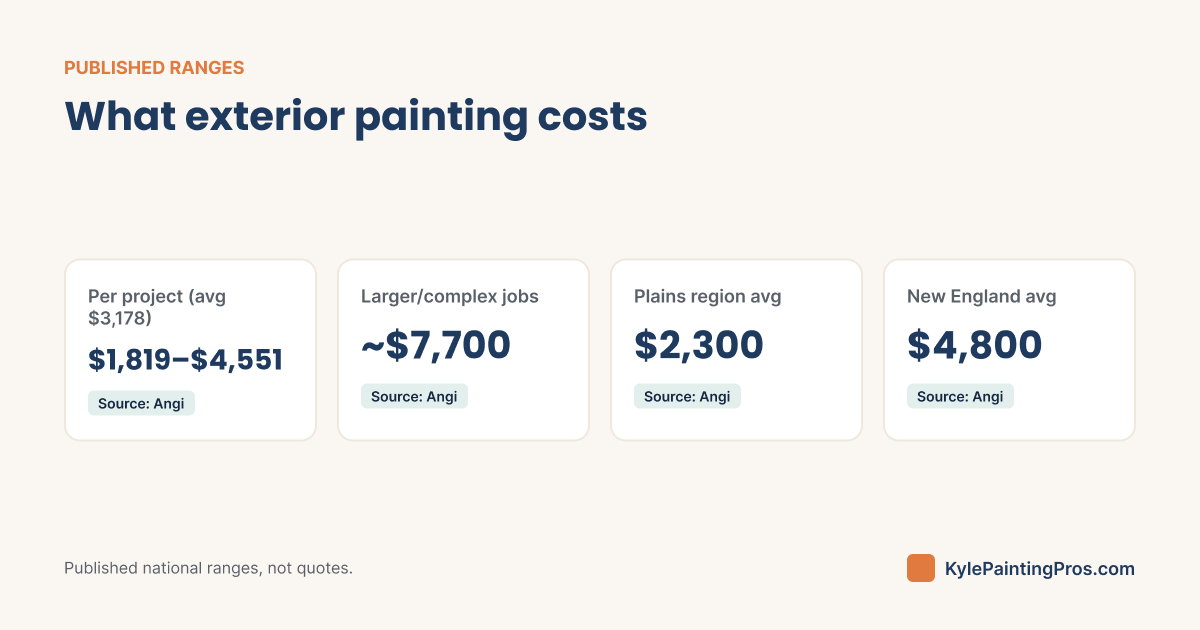
Quick answer: Angi reports that homeowners pay $1,819 to $4,551 to paint a house exterior, with an average of $3,178, based on 39,126 projects. Larger or more complex homes can reach about $7,700. Per square foot of paintable area, Angi lists $1.50 to $4.
Exterior house painting cost at a glance
| Item | Published figure | Source |
|---|---|---|
| Whole exterior (per project) | $1,819 to $4,551 (average $3,178) | Angi |
| Per sq ft of paintable area | $1.50 to $4 | Angi |
| Exterior trim | about $2 per linear ft | Angi |
| Soffits and fascia | $2.50 to $6 per linear ft | Angi |
| Exterior door | $150 to $500 each | Angi |
| Paint stripping | $0.50 to $2 per sq ft | Angi |
| Painter labor | $25 to $100 per hour | Angi |
Cost by siding type
Siding material affects prep, paint absorption, and labor. Angi’s ranges per square foot:
| Siding | Angi (Angi) | This Old House (This Old House) |
|---|---|---|
| Wood | $1 to $3 | $1.70 to $3.60 |
| Vinyl | $1.25 to $3 | $2.80 to $5.20 |
| Aluminum / metal | $1.50 to $2.50 | $2.10 to $4.20 |
| Stucco | $1.50 to $4 | $2.50 to $4.80 |
| Brick | $1.50 to $4.50 | $2.60 to $5.00 |
| Concrete | $1 to $3.50 | not listed |
This Old House figures come from a search summary of its 2026 guide and were not re-checked against the full page. We have not found a primary source for fiber-cement siding painting costs, so we don’t publish a range for it.
Notes by material:
- Wood needs the most prep: scraping, sanding, and priming bare spots. It rewards good prep with a long-lasting finish.
- Stucco and masonry are porous. A secondary source, CostToRenovate, notes stucco can absorb 30% to 50% more paint, so expect higher material use.
- Vinyl can be painted, but the color must be suitable for vinyl to avoid heat warping. Ask your painter about vinyl-safe colors.
Cost by height and stories
Height is one of the biggest exterior cost drivers because it slows the crew and requires ladders, lifts, or scaffolding. Angi lists these labor adders:
| Height | Added cost |
|---|---|
| Above 8 ft | +30% |
| Above 13 ft | +60% |
| Above 17 ft | +90% |
| Above 19 ft | +120% |
A two-story house is therefore far more than twice the cost of a single-story house with the same footprint once the upper walls are factored in.
Cost by region
Angi publishes average exterior project costs by region, against a national average of $3,178:
| Region | Average project |
|---|---|
| New England | $4,800 |
| Far West | $4,500 |
| Mideast | $4,300 |
| Southeast | $3,315 |
| Great Lakes | $3,000 |
| Rocky Mountains | $2,900 |
| Southwest | $2,400 |
| Plains | $2,300 |
Painter wages are a large part of these differences. The U.S. Bureau of Labor Statistics (OEWS, May 2025) reports a national median painter wage of $23.75 per hour, with large differences between metro areas.
How to estimate your exterior
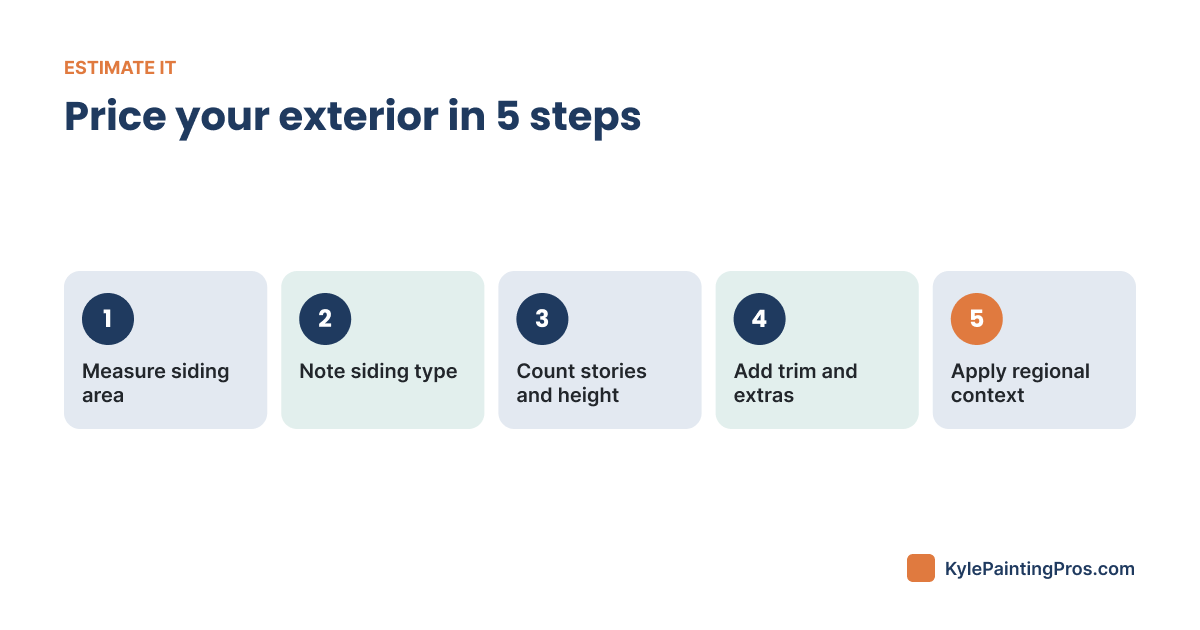
- Measure paintable area. For each wall, multiply length by height. For gable ends, use half the base times the height. Subtract large openings like garage doors.
- Apply a per-square-foot rate for your siding type from the tables above.
- Add height adders to upper-story areas.
- Add trim, soffits, fascia, and doors at their unit rates.
- Add prep such as stripping if paint is failing.
Our Painting Cost Estimator runs this math and shows low, typical, and high outcomes. To estimate gallons for a DIY job, use the Paint Calculator.
A worked example
Imagine 2,000 square feet of paintable wood siding on a single-story home. At Angi’s $1 to $3 per square foot for wood, siding comes to $2,000 to $6,000. Add 200 linear feet of trim at Angi’s $2 per linear foot, or $400. These are multiplications of published rates for illustration, not quotes.
Exterior paint costs
Angi lists exterior latex or acrylic paint at $20 to $50 per gallon, oil-based at $20 to $60, and primer at $15 to $80. A secondary aggregator, UseCalcPro, groups 2026 exterior paint from $28 to $45 (economy) up to $90 to $120 (premium-plus) per gallon.
Paint is a modest part of a professional job, but premium exterior paint can extend the time before your next repaint, which may make it the cheaper choice over time.
DIY vs hiring a pro
DIY can save the labor portion of the bill, but exterior work is a different risk level from interior work. Ladders, heights, weather windows, and heavy prep make many homeowners hire out at least the second story. If your home was built before 1978, scraping and sanding may disturb lead paint, which carries federal work-practice rules for contractors; have it tested before you start.
Questions to ask in a quote
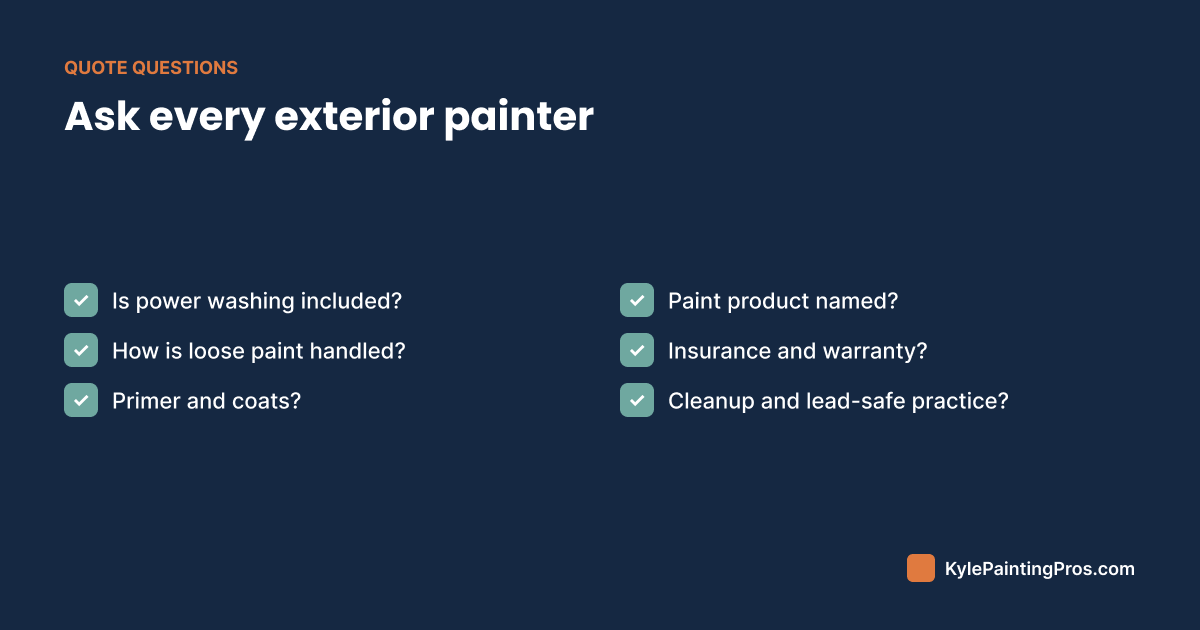
- What prep is included: power washing, scraping, caulking, priming?
- Which product and how many coats?
- Are trim, soffits, fascia, gutters, and doors included?
- How will height and access be handled?
- What is the warranty, and what does it cover?
Worked example: a two-story house with height adders
Imagine a two-story home with 1,200 square feet of vinyl siding on the ground floor and 1,200 square feet above 13 feet. Using Angi’s vinyl range of $1.25 to $3 per square foot and its 60% height adder (Angi). These are calculations, not quotes.
| Area | Calculation | Cost range |
|---|---|---|
| Ground floor | 1,200 x $1.25 to $3 | $1,500 to $3,600 |
| Upper story | 1,200 x $1.25 to $3 x 1.6 | $2,400 to $5,760 |
| Trim | 250 linear ft x $2 | $500 |
| Two exterior doors | 2 x $150 to $500 | $300 to $1,000 |
| Total | $4,700 to $10,860 |
Angi applies the height adder to labor, so applying it to the whole rate overstates the upper-story cost somewhat. Treat this as a conservative ceiling.
Worked example: estimating exterior paint
For 2,400 square feet of siding, two coats, at the 400 square feet per gallon HomeGuide cites for interior paint (exterior coverage is often lower on rough surfaces): 2,400 x 2 / 400 = 12 gallons. At Angi’s $20 to $50 per gallon for latex or acrylic (Angi), that’s $240 to $600 in paint, a small share of a professional bill.
Exterior house painting cost: what a good job includes
Two quotes for the same house can differ because one includes steps the other skips. Understanding the normal sequence makes it easier to compare exterior house painting cost estimates fairly.
- Inspection: the painter checks siding, trim, and caulk for rot, gaps, and failing paint.
- Cleaning: surfaces are washed to remove dirt, chalking, and mildew so new paint can bond.
- Scraping and sanding: loose and peeling paint is removed and edges are feathered.
- Repairs: small wood repairs and replaced caulk at joints, windows, and trim.
- Priming: bare wood, repairs, and stains get primer.
- Painting: body, trim, doors, and any accents receive finish coats.
- Cleanup and walkthrough: debris is removed and touch-ups are completed.
If a quote does not mention prep, ask. Prep is where long-lasting exterior jobs are won or lost.
Timing and weather
Paint needs suitable temperatures, dry surfaces, and a dry forecast to cure properly. Product labels list minimum application temperatures and recoat times, so follow the manufacturer’s instructions for the paint you choose. In many parts of the country, that makes spring through fall the main painting season, and contractors may book up early.
Ask your painter how they schedule around rain, how many days the job should take with their crew, and what happens if weather delays the start.
Older homes and lead-based paint
Homes built before 1978 may contain lead-based paint. Disturbing it during scraping and sanding can create hazardous dust. The U.S. Environmental Protection Agency’s Renovation, Repair and Painting (RRP) program requires contractors working on such homes to be certified and follow lead-safe work practices. If your home is older, ask whether the firm is RRP certified. Lead-safe practices add time and materials, which can raise the price.
Choosing exterior colors and finishes
Color choice has little effect on labor unless you are making a big change, which may require extra coats. Finish matters more for durability:
- Flat or low-sheen finishes are common on siding because they hide surface flaws.
- Satin balances durability and appearance, and is a frequent choice for body color.
- Semi-gloss is common on trim, doors, and shutters because it is hard and easy to clean.
Check any homeowners’ association rules before you pick colors, since some neighborhoods require approval.
Making an exterior paint job last
The cheapest exterior paint job is the one you do not have to repeat early. Help it last by:
- Keeping gutters clean so water does not run down the siding.
- Trimming plants and shrubs away from the walls.
- Washing the siding gently when it gets dirty.
- Re-caulking gaps around windows and trim as they open up.
- Touching up chips and failing spots before they spread.
A small amount of maintenance can delay the next full repaint and protect the siding underneath.
Using exterior house painting cost data to budget
Start with the published ranges in this guide to set a realistic budget, then narrow it with quotes. Use our Painting Cost Estimator for a quick check and our paint quantity guide if you plan to buy materials yourself. For how we collect and label every figure, see our painting cost methodology.
Exterior house painting cost: a scope checklist
Exterior quotes vary more than interior ones, so a written scope matters even more. List each item and ask every contractor to price the same list.
- Body siding, by elevation or the whole house.
- Trim, fascia, soffits, and gutters.
- Doors, shutters, garage doors, and railings.
- Decks, fences, and porches, which are often priced separately.
- Washing, scraping, sanding, and priming of bare areas.
- Caulking and minor wood repairs.
- Number of finish coats and the product line.
- Protection for plants, walkways, roofs, and windows.
A complete list keeps your exterior house painting cost comparable from bid to bid.
Worked example: same house, two scopes
Consider one two-story home priced twice. The first quote covers the siding body only, with one coat over a quick wash. The second covers siding, trim, fascia, and doors, with scraping, priming of bare wood, caulking, and two coats. The second quote is much higher, yet it may cost less per year because it lasts longer before the next repaint. When you compare exterior house painting cost estimates, compare what each one buys, not just the total.
Prep and paint quality factors
Surface prep
Exterior paint fails most often because of poor prep: dirt, chalking, mildew, and loose paint stop new coats from bonding. Washing, scraping, and spot priming are where much of the labor goes.
Product quality
Exterior paints differ in how well they resist UV, moisture, and mildew. Ask which product line your contractor uses and read its technical data sheet for coverage, minimum temperature, and recoat times.
Number of coats
Two coats usually last longer than one, especially on weathered siding or with a big color change. Ask each bidder how many coats they include.
Regional cost caveats
The ranges in this guide are national. Painter wages differ by state and metro area, as data from the U.S. Bureau of Labor Statistics shows, and climate changes how long the painting season lasts. Regions with short seasons can see higher demand and fuller schedules, which can push the exterior house painting cost upward during peak months.
DIY vs hiring a pro: a decision framework
- DIY is realistic for a single-story home with sound siding, safe ladder access, and a few weeks of good weather.
- Hire a pro for second stories, steep grades, heavy scraping, older homes that may contain lead paint, or when you lack time.
- Hybrid option: hire the high work and do the fences, railings, or deck yourself.
Factor in equipment rental, ladders, sprayers, and safety gear when you compare DIY with a pro’s exterior house painting cost.
Common estimate mistakes
- Comparing quotes that include different prep.
- Forgetting soffits, fascia, and gutters.
- Ignoring the height adders listed in published ranges.
- Assuming one coat will cover a dramatic color change.
- Booking without confirming lead-safe certification on pre-1978 homes.
Avoiding these keeps your exterior painting budget realistic and your finish durable.
Budgeting for exterior house painting cost over time
Exterior paint is a recurring expense, not a one-time project. Sun exposure, moisture, and siding type all affect how long a finish lasts. A simple way to plan is to divide a realistic quote by the number of years you expect it to last, then compare quotes on that yearly figure. A slightly higher exterior house painting cost that includes thorough prep and two coats can be the better value if it lasts noticeably longer. Inspect the house once a year, touch up failing spots early, and keep caulk joints sealed so the next full repaint can wait.
Key takeaways
- Exterior house painting cost rises with height, siding condition, and prep needs.
- Compare quotes on identical scope, since prep differences explain much of the gap in exterior house painting cost.
- Maintenance between repaints helps keep your long-term exterior house painting cost down.
Before you request bids, gather the details that shape exterior house painting cost: the siding material, the number of stories, the trim and doors you want painted, and any rot, peeling or bare wood that needs repair. Photos of each side of the house help painters quote the same scope. Ask every contractor whether the price includes pressure washing, scraping, caulking, primer and two finish coats. When the scope lines up, differences in exterior house painting cost usually come down to prep quality, product choice and labor rates, and those are much easier to judge side by side.
Work out exterior gallons with our paint quantity guide, see why exterior quotes and guides differ, and read how we source and label prices. The Painting Cost Estimator gives a quick budget check.
Frequently asked questions
How much does it cost to paint a two-story house exterior?
There’s no single sourced figure, but height adders from Angi of 30% to 120% above 8 feet mean upper stories cost substantially more per square foot than ground floors.
What is the cheapest siding to paint?
In Angi’s published ranges, wood and concrete have the lowest starting points at $1 per square foot, but wood often needs the most prep.
How often should I repaint?
It depends on climate, siding, and paint quality. Read the manufacturer’s guidance and inspect for peeling, chalking, and fading every year.
Does power washing cost extra?
Often it’s included in prep. Ask the painter to list it in the quote.
Is stripping old paint necessary?
Only when paint is failing badly. Angi lists stripping at $0.50 to $2 per square foot, so it adds up quickly on a full house.
Why is my region more expensive?
Angi‘s regional averages range from $2,300 in the Plains to $4,800 in New England, driven largely by labor costs.
Does exterior house painting cost include trim and doors?
Sometimes. Some quotes cover the siding body only, while others include trim, fascia, soffits, doors, and shutters. Ask for a line-by-line scope.
Why is exterior house painting cost higher for older homes?
Older homes often need more scraping, wood repair, and priming, and homes built before 1978 may need lead-safe practices under the EPA RRP rule, which adds time and materials.
Can I lower exterior house painting cost by doing the prep myself?
Possibly, but discuss it first. Many contractors prefer to handle prep because their warranty depends on it. Washing and clearing plants are easier tasks to take on.
Is one coat enough on an exterior?
One coat may work for a same-color refresh on sound paint, but two coats usually last longer, especially on weathered surfaces or with a color change.
Does color choice change exterior house painting cost?
Color itself rarely changes labor, but a dramatic change, such as dark to light, may need primer or an extra coat. That adds labor and materials, so mention planned color changes when you request quotes.
Sources
- Angi, updated Oct 20, 2026, accessed Nov 4, 2026.
- This Old House, 2026 (from search snippet; not re-fetched), accessed Nov 4, 2026.
- UseCalcPro (secondary aggregator), accessed Nov 4, 2026.
- U.S. Bureau of Labor Statistics (OEWS, May 2025), May 2025.
Read our cost methodology for how we handle scope and updates.
Notes